
EBITDA valuation: same EBITDA, different maintenance cash
Key Takeaways
- EBITDA, in the sense of Exchange Act Release No. 47226, starts from net income and adds interest, taxes, depreciation and amortization.
- A further add-back carries the title adjusted EBITDA. SEC staff Question 103.02 reconciles EBIT and EBITDA, presented as performance measures, to net income.
- The worked multiple is 7.0 only as an assumption. Both invented mills then have an enterprise value of 700.
- North mill's maintenance cash is 18 and South mill's is 46, so the cash left beside the same EBITDA is 82 and 54.
Research Scope
- Regions
- No country. North mill and South mill are invented.
- Period
- SEC staff page last update December 13, 2022. Question 103.01 answer dated January 11, 2010. Question 103.02 answer dated May 17, 2016. Damodaran introduction read from the copy fetched October 11, 2026. The dollar figures have no fiscal year.
- Industries
- Industrial mills in the worked tables. A resource producer can use the same net-income rebuild. This page does not supply a mining cost metric.
- Data objects
- Net income, interest, income taxes, depreciation and amortization, EBITDA, adjusted EBITDA, an assumed EV/EBITDA multiple, enterprise value, and maintenance cash.
A shared EBITDA figure fails the cash check when the upkeep bills differ. An EBITDA valuation uses an EV/EBITDA multiple and sets the price of the firm, borrowings included. This page rebuilds EBITDA from net income, applies one labeled hypothetical multiple, and compares two invented industrial mills that share the EBITDA and spend different cash to keep the plant running.
The dollars below are hypothetical millions. North mill and South mill are not issuers. The 7.0 multiple is an assumption written so the arithmetic has a number. It is not a market reading, a sector average, or a price target. Company valuation multiples is where a published industry figure gets its region, year, industry name and loss-making sample written down before anyone reuses it.
Table 1. Inputs for an EBITDA valuation. The rule column cites the SEC staff page or Damodaran’s introduction, both read October 13, 2026. The multiple row is deliberately blank of any market figure.
Scroll horizontally to view all columns.
| Input | What to write | Why it changes the result |
|---|---|---|
| Earnings inside the EBITDA name | Net income from the statement of operations | Question 103.01: in Release 47226, “earnings” means that net income |
| EBITDA | Net income plus interest, taxes, depreciation and amortization, as that release names them | A different add-back list needs a different title |
| Adjusted EBITDA | Further items, under that title | Question 103.01 gives “Adjusted EBITDA” as the example title when the calculation differs |
| Reconciliation target | Net income on the statement of operations | Question 103.02, answer dated May 17, 2016. Operating income is the wrong target for this measure |
| Numerator | Enterprise value of the firm | EBITDA is struck before interest, so it lines up with Damodaran’s firm claim |
| Multiple | A figure you supply, with region, year, industry and sample | This page does not print a market multiple |
| Maintenance cash | Cash spent to hold current capacity | Two firms can share EBITDA and still differ here |
Rebuild EBITDA from net income
Question 103.01 quotes Exchange Act Release No. 47226. That release describes EBIT as earnings before interest and taxes, and EBITDA as earnings before interest, taxes, depreciation and amortization. The staff answer says “earnings” means net income as presented in the statement of operations under GAAP. A measure calculated differently should not be characterized as EBITDA. Its title should be distinguished, and the answer’s own example is “Adjusted EBITDA.” Those other measures are not exempt from the prohibition in Item 10(e)(1)(ii)(A) of Regulation S-K, with the exception of measures addressed in Question 102.09.
Question 102.09 is a narrow case. It concerns a material credit-agreement covenant that management believes investors need in MD&A, even though the covenant’s adjusted EBITDA excludes charges that require cash settlement. The answer lists extra disclosures for that situation: the material terms, the compliance limit, and the effect of compliance. It does not rename that covenant calculation as EBITDA.
Question 103.02, answer dated May 17, 2016, says that if EBIT or EBITDA is presented as a performance measure, reconcile it to net income as presented in the statement of operations under GAAP. The same answer says operating income would not be considered the most directly comparable GAAP financial measure, because EBIT and EBITDA make adjustments for items that are not included in operating income. It also says these measures must not be presented on a per share basis.
Table 2 follows that order for the two invented mills. Start at net income. Add interest, income taxes, and depreciation and amortization. The sum is the EBITDA the release describes. The plant-closure row is outside that description, so the line under it is adjusted EBITDA. Every cell is a hypothetical million dollars. There is no fiscal year and no filing.
Table 2. Net income, EBITDA and adjusted EBITDA. Hypothetical millions of dollars. Source of the row rules: SEC staff Questions 103.01 and 103.02, read October 13, 2026. The amounts are invented.
Scroll horizontally to view all columns.
| Line | Inside the Release 47226 EBITDA name? | North mill | South mill |
|---|---|---|---|
| Net income | Starting GAAP total | 46 | 62 |
| Interest | Add | 10 | 10 |
| Income taxes | Add | 16 | 20 |
| Depreciation and amortization | Add | 28 | 8 |
| EBITDA | Sum of the four rows above | 100 | 100 |
| Cash plant-closure cost | Outside that name | 0 | 9 |
| Adjusted EBITDA | EBITDA plus the plant-closure row | 100 | 109 |
North mill: 46 + 10 + 16 + 28 = 100. South mill: 62 + 10 + 20 + 8 = 100. South mill’s net income is 16 higher, its tax add-back is 4 higher, and its depreciation and amortization add-back is 20 lower. Those three gaps offset, which is why the EBITDA totals match. South mill’s adjusted EBITDA is 109 only because the table adds a 9 cash closure cost that the Release 47226 name does not include. The multiple in the next section uses 100 for both mills.

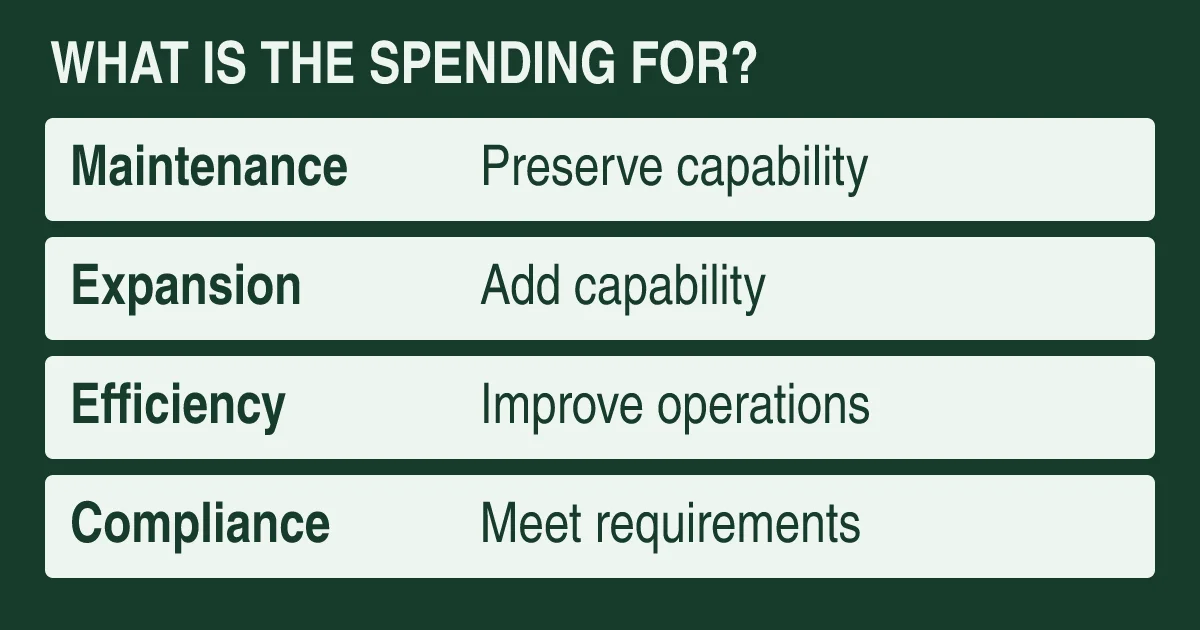
Depreciation and amortization in Table 2 are the add-backs inside the EBITDA name. They are accounting allocations. South mill’s add-back is 8 and North mill’s is 28, so South mill looks stronger on net income while adding back less. The cash spent to hold capacity is a different column, and it runs the other way. Types of capital expenditure separates maintenance, expansion, efficiency and compliance as research labels, and it keeps a company’s own wording attached to those labels. Table 3 uses one invented cash amount for upkeep. It does not classify that cash as capital expenditure or operating expense.
Price the firm with an enterprise multiple
Damodaran’s introduction splits discounted cash flow into two jobs. Firm valuation, which he also calls enterprise valuation, values the whole business. The cash flows before debt payments and after reinvestment needs are free cash flow to the firm, discounted at the cost of capital. Equity valuation values the equity stake. Its cash flows are after debt payments, discounted at the cost of equity. He writes that equity value follows from firm value once every non-equity claim is removed, when the two routes are done consistently.
EBITDA, as Release 47226 names it, is struck before interest. The reading on this page is that the matching numerator is enterprise value, the firm claim, rather than market capitalization. Damodaran’s page does not define EBITDA, and it does not print an EV/EBITDA column. The pairing is this page’s application of his firm-versus-equity split to the earnings definition in the release. What is the valuation of a company? is the log for marking each input as a disclosure, an assumption, or an estimate before that pairing is used on a real filing.
In the relative-valuation section he standardizes a market price by earnings, book value or revenue, because the price per share moves with the share count. He also writes that comparable assets, from a valuation standpoint, have similar cash flows, risk and growth, while in practice the set is often other companies in the same business. Those are different filters. In the limitations section he adds that a multiple taken from a group carries whatever overvaluation or undervaluation is already in the group, and that the assumptions behind a multiple are often left unstated. This page does not choose a peer group and does not print his illustration numbers. The place to copy a published sector cell, with its sample named, is the company valuation multiples note.
The worked multiple is 7.0 for both mills. It exists so the multiplication can be checked. Enterprise value equals EBITDA times that multiple: 100 × 7.0 = 700 for North mill and 100 × 7.0 = 700 for South mill. Applying the same 7.0 to South mill’s adjusted EBITDA of 109 would produce 763. This page keeps the multiple on the Release 47226 EBITDA of 100. Non-equity claims are left out, so the example stops at enterprise value. Damodaran’s step from firm value to equity value is to subtract those claims. Inventing a debt balance here would hide the maintenance comparison.
Compare two mills that share one EBITDA figure
The two mills now have the same EBITDA and the same assumed enterprise value. Their maintenance cash does not match. North mill spends 18 to hold current capacity. South mill spends 46. Subtract that cash from EBITDA and the remainders are 82 and 54. The gap of 28 is the maintenance gap. The multiple never sees it.
Table 3. Same EBITDA, different maintenance cash. Hypothetical millions of dollars except the 7.0 multiple, which is an assumed count of times. The 7.0 is not a market statistic.
Scroll horizontally to view all columns.
| Item | North mill | South mill |
|---|---|---|
| EBITDA used in the multiple | 100 | 100 |
| Assumed EV/EBITDA multiple | 7.0 | 7.0 |
| Enterprise value, 100 × 7.0 | 700 | 700 |
| Maintenance cash to hold current capacity | 18 | 46 |
| EBITDA minus that maintenance cash | 82 | 54 |

South mill’s lower depreciation add-back sits next to the higher maintenance cash. An older asset base can show a small depreciation charge after the assets have already been written down, while the cash to keep the plant running stays large. That pattern is the reason Table 2 and Table 3 are separate. Adding back a small depreciation number does not tell you the upkeep bill.
The remainder, 82 or 54, is still short of free cash flow to the firm as Damodaran defines it. His free cash flow to the firm is the cash flow before debt payments and after reinvestment needs. EBITDA minus maintenance cash still includes income taxes and working capital, and the table has recorded no growth spending. The subtraction is a cash check beside the multiple. Record taxes, working capital and any expansion cash before you treat the remainder as his free-cash-flow figure.
A resource producer can run the same net-income rebuild. A sustaining-cost line in a technical report is a separate definition, written by the company or by the reporting code. Copy that definition, with its date, before you put the number in the maintenance row of Table 3. This page does not supply a mining cost metric, and it does not convert Table 3 into a reserve or a mine value.
Write down the year before you capitalize it
Damodaran’s limit on multiples is that the assumptions often stay unstated, and a comparison with a group carries the pricing of that group. A single year of EBITDA in the denominator capitalizes that year. For a cyclical resource producer or a cyclical equipment maker, a peak year and a trough year are different denominators. This page does not choose which year is representative. Write the year next to the EBITDA you use, and write “unstated” when the source does not say where that year sits in the cycle.
The 7.0 above cannot fill that blank. It was chosen for the arithmetic, with no region, no sample and no date attached. A sector multiple copied from a dataset needs the checklist on the company valuation multiples page: region, year, industry name as printed, and whether the cell is the positive-EBITDA sample or the all-firms sample. Leave any one of those blank and the multiple is not ready to reuse. This page does not reprint those sector cells.
How these figures were checked
The staff sentences are Questions 103.01 and 103.02 on the SEC non-GAAP page. The page heading says last update December 13, 2022. The 103.01 answer is dated January 11, 2010, and the 103.02 answer is dated May 17, 2016. Damodaran’s sentences are from the three sections named in the source list. Both documents were read on October 13, 2026 from copies fetched on October 11, 2026. Staff guidance constrains how a registrant presents the measure. It does not set a multiple and it does not value a firm.
Every dollar amount in Tables 2 and 3 was chosen for the arithmetic and labeled hypothetical. Changing 7.0 changes 700. Changing South mill’s plant-closure add-back changes 109 and would change 763 if that adjusted total were the denominator, which it is not. Changing 18 or 46 changes 82 and 54. None of those cells will be updated when a company files, because no company filed them. Nothing here is a bid, a target, or a view on a security.
Frequently asked questions
What GAAP total should EBITDA be reconciled to?
Net income as presented in the statement of operations under GAAP. Question 103.02 says operating income would not be considered the most directly comparable GAAP measure, because EBIT and EBITDA adjust for items that operating income does not include. The same answer says the measures must not be presented on a per share basis.
Why do the two mills show the same enterprise value?
Both are assigned EBITDA of 100 and the same assumed multiple of 7.0, so both enterprise values are 700. The maintenance cash is 18 and 46, and that gap never enters the multiplication. The 7.0 is an assumption written for the arithmetic. It is not a market multiple.
Does EBITDA minus maintenance cash equal free cash flow to the firm?
Damodaran defines free cash flow to the firm as cash flow before debt payments and after reinvestment needs. EBITDA minus the maintenance cash in Table 3 still includes taxes and working capital, and the table records no growth spending. The subtraction is the cash check beside the multiple.
Continue the research
Related Research

Company valuation multiples: pair the claim with the measure
Which valuation multiple matches the claim, and what has to be written down before an industry figure is copied?

What is the valuation of a company?
What has to be written down before a company valuation figure can be compared with another figure?
Types of CapEx: Maintenance and Growth
How can a reader identify what capital spending is intended to do without treating a management classification as a standard accounting disclosure?
Sources & Data Notes
-
Heading on the page: Last Update: December 13, 2022. Question 103.01 answer bracketed January 11, 2010. Question 103.02 answer bracketed May 17, 2016. Read from the saved fetch of October 11, 2026. Staff guidance on presentation, not a valuation formula and not a market multiple.
-
Used for the firm-versus-equity cash-flow split, for standardizing a market price by earnings, book value or revenue, and for the limit that a peer comparison carries the group's pricing. The page does not define EBITDA. Read from the saved fetch of October 11, 2026.