
Editorial Policy & Research Methodology
How Stock Research Portal Blog chooses sources, presents data, credits authors, uses AI tools, records corrections and labels links.
These are the standards we apply to the research we publish, and they describe how we intend to work. Each article also lists its own sources, scope and revision history, so readers can judge the evidence for themselves.
What we publish and what we leave out
We publish research on resources, industrial sectors, company disclosures and capital spending, with focused coverage of packaging machinery and its end markets. Our aim is to answer clearly defined questions with identifiable sources and to explain the assumptions and limits behind any estimate.
We do not publish stock tips, trading signals, price targets or real-time market data. We do not quote machine prices or recommend suppliers.
How we choose and cite sources
We prefer primary sources: statistical agencies, regulators, standard-setting bodies, company filings and the original publication of a dataset, over secondary summaries.
A commercial report page or press release shows what its publisher claims. We do not treat it as confirmation from a separate source, and we cite only content that is publicly available to us.
For each source we record the publisher, the period it covers and a locator such as a table, section or page, together with the date we accessed it. We keep reported facts, estimates, forecasts and illustrative examples apart and label them as such.
Two rules limit what we print. If a market size, growth rate or share cannot be traced to a source we have opened, we leave it out and explain what data would be needed. And where sources use different years, regions, currencies or definitions, we do not combine them into a single series.
Our Data Sources directory lists the primary sources we rely on most, with their coverage, update frequency, usage limits and the date we last checked each link.
How data is presented
Tables and charts carry a title, unit, region, period and source. Each is labeled as actual, estimate or illustrative. Illustrative examples use round hypothetical figures, are marked as hypothetical and are never presented as company data.
Authors and review
Articles are published under the real name of the responsible author. When a qualified review has taken place, the reviewer is shown on the article. We do not invent credentials, titles or experience for authors or reviewers. Articles do not display a publication date. Any date we show, such as the updated date after a substantive update or a date in the revision history, reflects when the change actually happened, and we never backdate content.
Use of AI tools
AI tools may assist with locating sources, outlining, drafting and language editing. A named human author is responsible for every published article: before publication, the author checks every factual statement, figure and citation against the original source and revises the text as needed. AI tools are not listed as authors, and they are not used to generate data or to stand in for a source.
Updates and corrections
When we make a substantive update to an article, we change its updated date and add an entry to its revision history. Minor edits such as typo fixes do not change the updated date.
We record corrections on the Corrections & Updates page. Readers who believe an article contains an error can report it through the Contact page.
Links
We use descriptive anchor text. We include a link only where the linked page provides the material we refer to. Any paid, sponsored or advertising link is labeled as such and marked with rel="sponsored".
Not investment advice
Our research is for general information. It is not personalized investment advice or a recommendation to buy, sell or hold any security. See our Terms & Research Disclaimer.
From source to publication
Each article moves through the same sequence.
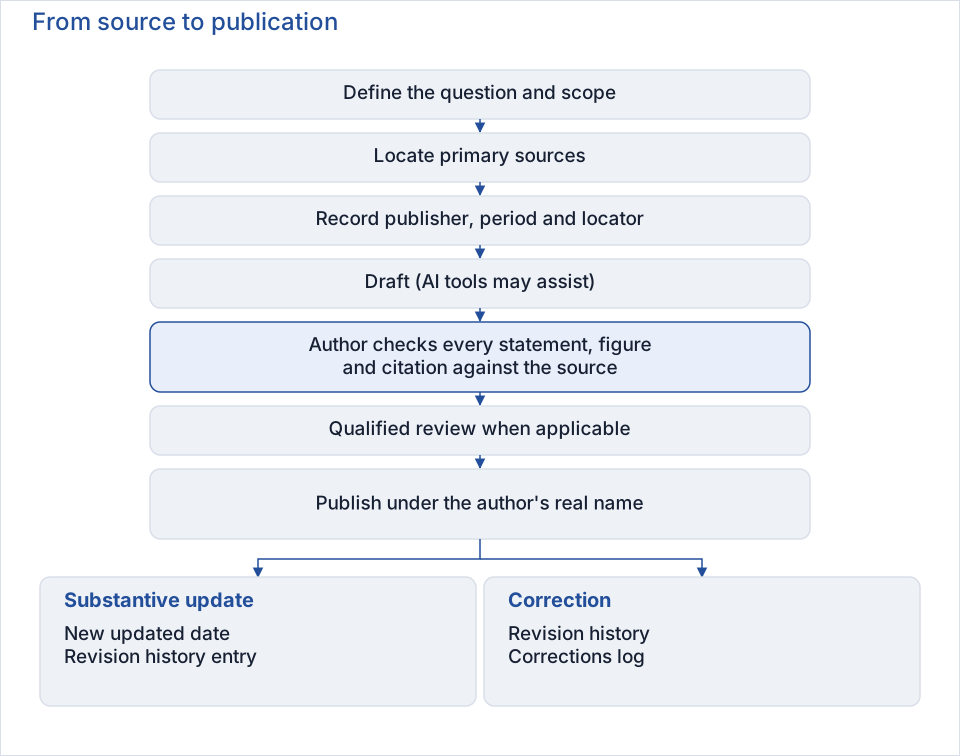
- We define the research question and the region, period and industries it covers.
- We look for statistical agencies, regulators, standards bodies, company filings and the original publication of each dataset.
- For each source we note the publisher, the period covered and a locator, such as a table, section or page.
- A draft is prepared under the responsibility of the named author. AI tools may assist with locating sources, outlining, drafting and language editing.
- The named author checks every statement, figure and citation against the original source.
- Where a qualified review applies, a reviewer reads the article and is shown on it.
- The article is published under the author’s real name. We keep an accurate internal record of when it was published and never backdate it.
- Later changes are dated and recorded, as described in Corrections & Updates.
How we check a figure
Before a figure appears in an article, we confirm each of the following against the source.
- Which year, quarter or date does it describe?
- Does the geography match the article’s scope?
- Is it units, tonnes, dollars or a percentage, and in thousands or millions?
- Which currency applies, and is it nominal or inflation-adjusted?
- Is it reported, estimated by the publisher or projected?
- What does the source include, for example machines only or also parts and services?
- Is it preliminary, revised or final?
- Can a reader find it again from the table, section or page we cite?
A figure that fails a check is corrected, labeled or left out. We do not combine figures that differ on period, region, unit or definition.
Illustrative examples are labeled, as in Mining Company Valuation, and are never used as evidence.
How each source type is treated
| Source type | How we use it | Limits |
|---|---|---|
| Official statistics | Primary basis for sizes, trends and trade or production data | Definitions and release schedules vary |
| Regulators and standards | Definitions, disclosure rules and reporting standards | Describe rules, not business outcomes |
| Company disclosures | Reported results, orders, capital spending and risk statements | Use the company’s own definitions |
| Industry associations | Sector context and survey summaries | Coverage may be partial; full reports may be paid |
| Commercial reports | Cited only for what the public page states | Not independent confirmation; methods often not public |
| News | Context and dating of events | Secondary; claims are traced to a primary source |
The Data Sources directory lists the primary sources we rely on most. See the Terms & Research Disclaimer for permitted use.