
Corrections & Updates
How to report a factual error on Stock Research Portal Blog, how we tell corrections from updates, and how corrections are recorded.

We want our articles to be accurate. When a reader finds an error, we review it against the source and correct the article if the error is confirmed.
How to submit a correction
Send your correction through the Contact page. A report is quicker to review when it includes:
- the URL of the article;
- the statement you believe is wrong, quoted or described as exactly as you can;
- what you believe is correct; and
- the source that supports the correction, with a link, report name, period and page or section where possible.
We check each submission against the original source. We may ask follow-up questions, and we do not change an article on an unsupported claim.
Corrections and updates
A correction fixes something that was wrong when it was published, for example a misquoted figure, a wrong period or unit, a misattributed source or a misstated definition.
An update reflects new information after publication, for example a newer edition of a dataset, a revised standard or a changed rule. An update does not mean the earlier text was wrong.
Typo and formatting fixes that do not change meaning are not recorded as corrections.
What happens to a report
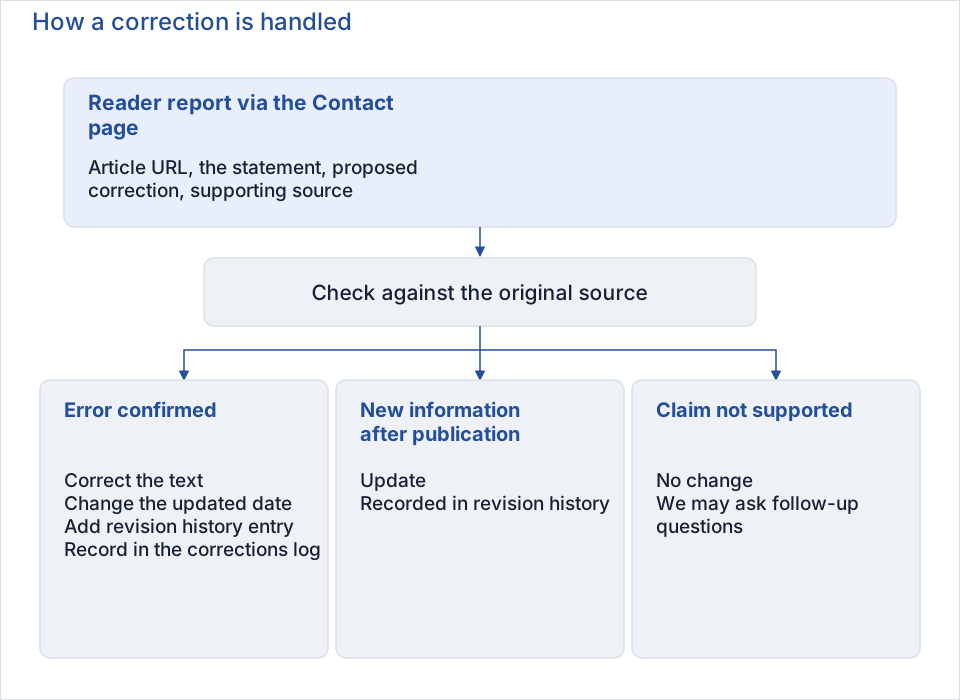
- A reader sends a report through the Contact page.
- We compare the statement with the original source, including its period, unit, region and definition, using the same checks described in our Editorial Policy. If the source has been revised since publication, we also check which version the article should have used.
- The check ends in one of three outcomes:
- If the error is confirmed, we correct the text, change the updated date, add a revision history entry and record the correction in the log below.
- If the report points to a newer release or changed rule, we update the article and record it in the revision history.
- If the report is unsupported, we make no change. We may ask follow-up questions, and a reader can resubmit with a source.
What counts as a correction
- A figure attributed to the wrong period, for example a 2022 value presented as 2023.
- A wrong unit or scale, such as thousands read as millions, or tonnes read as pounds.
- A statement attributed to the wrong source or publisher, including a figure taken from a commercial page that was presented as an official statistic.
- A region or scope mismatch, such as a global figure described as a figure for one country.
- A misstated definition, such as describing a standard or a disclosure term incorrectly.
- An arithmetic error in an illustrative example, even though its figures are hypothetical. Examples of this kind appear in articles such as Mining Company Valuation.
- A source link or locator that no longer supports the statement it is cited for, where the original data can be traced through the Data Sources directory.
Differences of interpretation
A correction concerns a fact that can be checked against a source, such as a number, a date or an attribution. A difference of interpretation concerns judgment, for example which factors matter most in a framework or how a limitation should be weighed. Our articles state their assumptions and limits so readers can disagree on reasoned grounds.
If you disagree with an analysis, we welcome the comment and the reasoning behind it, including which assumption you would change and what evidence supports your view. We may add a limitation or clarify wording where the reasoning is unclear. We do not record a difference of interpretation as a correction unless it exposes a factual error. The Editorial Policy explains how we separate reported facts from analysis.
Two practical points help reports move faster. First, one report per issue is easier to check than a long list of mixed points, although several related errors in one article can be sent together, ideally in a numbered list with the statement and the supporting source for each. Second, say whether you checked the current version of the article, since an earlier copy may already have been corrected.
Where changes appear
A correction or substantive update changes the article’s updated date and adds an entry to its revision history. Corrections are also listed in the log below with their date, the article affected and what changed.
Readers comparing an older copy of an article with the current one can use the revision history to see which statements changed. An update that reflects a newer data release is recorded as an update and not described as an error, so the history stays accurate about why each change was made. Typo and formatting fixes that do not change meaning are not logged.
How corrections are recorded
For a correction we change the article text, update the article’s updated date and add an entry to its revision history. We also record the correction below with its date, the article affected and what changed. For an update, we record the change in the article’s revision history.
The correction log below is generated from our records.
Recorded corrections
No corrections have been recorded.