
Capex vs Opex in Industrial Manufacturing and Machinery
Key Takeaways
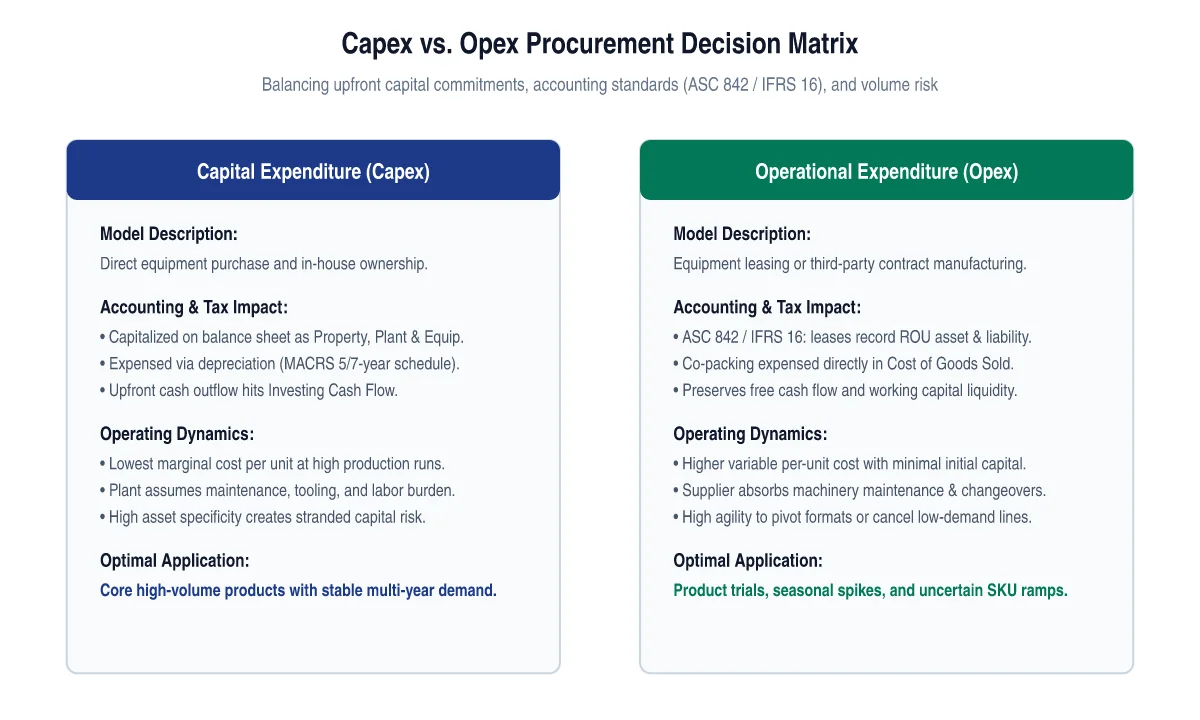
- Direct machinery purchasing (Capex) yields the lowest unit manufacturing costs at scale, but concentrates balance sheet liquidity and introduces utilization risk.
- Operational alternatives (Opex)—including equipment leasing and contract packaging (co-packing)—trade higher variable unit costs for volume flexibility and preserved working capital.
- Modern lease accounting standards (US GAAP ASC 842 and IFRS 16) require operating leases exceeding 12 months to be recognized on balance sheets as Right-of-Use (ROU) assets and liabilities, eliminating off-balance-sheet financing loopholes.
- The financial decision hinges on unit volume predictability, asset specificity, and the plant's cost of capital relative to asset internal rate of return (IRR).
Research Scope
- Regions
- Global; accounting context references US GAAP and IFRS
- Period
- Structural explainer
- Industries
- Industrial manufacturing, packaging machinery, food and beverage processing
- Data objects
- Balance sheet presentation, depreciation schedules, cash flow statements, leasing standards
Every industrial manufacturing business requiring additional packaging or processing capacity faces a foundational capital allocation decision: should the enterprise acquire and own the machinery through capital expenditure (Capex), or access capacity as an ongoing service through operational expenditure (Opex)?
Historically, companies treated Capex and Opex as distinct accounting silos. Today, evolving accounting standards, equipment-as-a-service (EaaS) contracts, and advanced contract packaging markets have transformed this into a strategic financial optimization problem.
1. Defining Capex and Opex in Equipment Acquisition
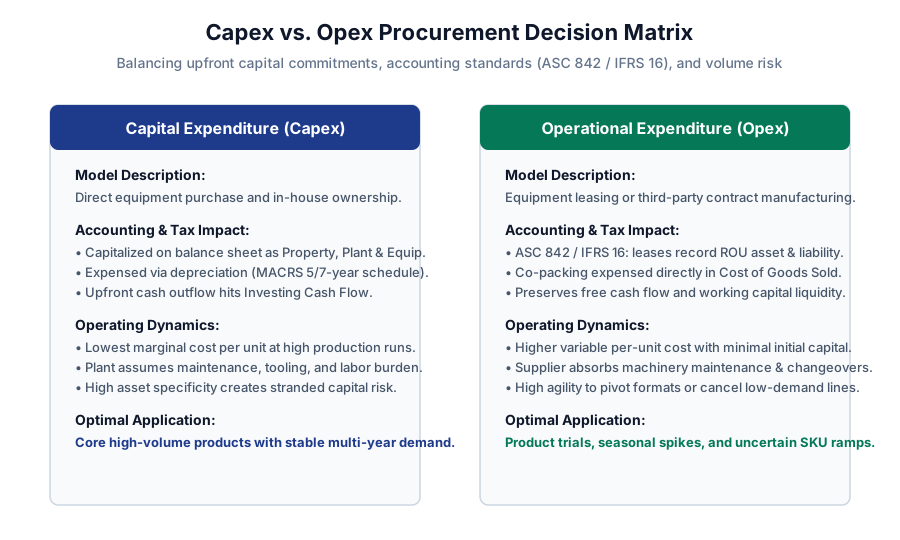
In manufacturing, the boundary between Capex and Opex dictates how cash outflows flow through corporate financial statements:
- Capital Expenditure (Capex): Outlays directed toward acquiring, installing, and upgrading long-term physical assets (such as rotary liquid fillers, high-speed cartoners, or end-of-line palletizing cells). Under accrual accounting, Capex does not immediately reduce net income; it is capitalized on the balance sheet as Property, Plant & Equipment (PP&E) and systematically expensed over its useful economic life via depreciation.
- Operational Expenditure (Opex): Day-to-day ongoing expenses necessary to operate manufacturing facilities. In equipment procurement, Opex includes operational lease payments, third-party contract manufacturing tolling fees, preventive maintenance service contracts, and consumable spare parts. Opex is deducted directly from revenue in the period incurred, reducing operating profit (EBITDA).
How companies split and disclose these categories is explored in maintenance capex vs growth capex.
2. The Accounting Shift: ASC 842 and IFRS 16
For decades, CFOs favored equipment leasing because “operating leases” were kept off corporate balance sheets, allowing companies to improve perceived return on assets (ROA) while keeping debt ratios low.
The implementation of FASB ASC 842 (under US GAAP) and IFRS 16 (under International Financial Reporting Standards) closed this loophole:
- Mandatory Balance Sheet Capitalization: Lessees must now recognize a Right-of-Use (ROU) Asset and a corresponding Lease Liability on the balance sheet for virtually all leases with a term exceeding 12 months.
- Finance Lease vs. Operating Lease Treatment:
- Under Finance Leases (or IFRS leases), the lessee front-loads expenses by recognizing separate amortization of the ROU asset and interest expense on the liability.
- Under US GAAP Operating Leases, lease expense is recognized on a straight-line basis over the lease term as a single operating cost, but the asset and liability remains visible on the balance sheet.
- Debt Covenant Impacts: Because lease liabilities are classified as debt obligations by rating agencies and lenders, leasing equipment no longer provides an artificial shield against balance sheet leverage constraints.
3. Financial Comparison: Purchasing vs. Leasing vs. Co-Packing
To evaluate how each model behaves under volume uncertainty, consider three primary pathways for bringing a new packaging format to market:
| Attribute | Direct Capex Purchase | Equipment Operating Lease | Contract Packaging (Opex) |
|---|---|---|---|
| Upfront Cash Requirement | High (100% equipment + installation) | Low (first month + security deposit) | Zero capital commitment |
| Balance Sheet Footprint | PP&E asset added; cash or debt | ROU asset and lease liability added | Clean (no balance sheet impact) |
| Unit Marginal Cost | Lowest ($0.08 – $0.15 per pack) | Moderate ($0.18 – $0.25 per pack) | Highest ($0.35 – $0.55 per pack) |
| Break-Even Volume | High (>2.5M packs/year) | Moderate (1.0M – 2.0M packs/year) | Low (<500k packs/year) |
| Volume Flexibility | Low (idle capacity creates loss) | Low (fixed monthly lease commitments) | Extreme (scale up or down freely) |
| Maintenance & Changeovers | Internal engineering responsibility | Shared SLA depending on lease contract | Fully handled by co-packer |
For industry dynamics surrounding contract manufacturing, see our analysis of the contract packaging industry.
4. Key Decision Criteria for Industrial Buyers
When choosing between Capex and Opex structures, management teams evaluate four primary hurdles:
- Volume Certainty and Demand Horizon: For mature, high-volume products with stable multi-year customer commitments, Capex ownership delivers superior financial returns over a 7- to 10-year horizon. For emerging product lines, seasonal limited-edition runs, or unproven packaging designs, Opex contract packaging eliminates asset write-down risks if market adoption lags.
- Asset Specificity and Reusability: Standard cartoners and stretch wrappers retain high secondary resale value; custom-engineered high-speed pouching lines customized for a single container shape carry severe stranded capital risk.
- Internal Operational Competence: Packaging lines require specialized electro-mechanical maintenance talent. If a plant lacks experienced automation technicians, an Opex service contract with OEM-backed uptime guarantees or contract packing protects overall equipment effectiveness.
- Corporate Cost of Capital: When interest rates are elevated and equity capital is constrained, preserving free cash flow for core R&D or market acquisition makes Opex models far more attractive than multi-million dollar machinery outlays.
To understand macro forces influencing machinery procurement timing, read interest rates and capital expenditure and automation investment drivers.
Continue the research
Sources & Data Notes
-
Defines balance sheet recognition requirements for operating leases as right-of-use assets and lease liabilities.
-
Single lessee accounting model requiring all leases to be brought onto balance sheets as asset and debt obligations.