
Valuation & Company Research
Resource and industrial companies can be studied from their public disclosures. The articles here cover valuation methods, the financial statements and operating metrics behind them, and the questions that expose risk.
Topics include mining company and mineral asset valuation, enterprise value and equity value, cyclical earnings, machinery company analysis and how order backlogs and revenue are reported. Worked examples use clearly labeled hypothetical figures, not company data.
The articles are method guides and research checklists that readers can apply to filings themselves. They show what to ask of a company and do not tell readers what to buy, sell or hold.

What this section covers
- How to value a mining company, and how company, project and asset-level valuation differ.
- What goes into net asset value and discounted cash flow models for mining projects.
- How enterprise value and equity value differ and why the distinction matters in resource and industrial research.
- How to value a cyclical business without extrapolating a single strong or weak year.
- How to read a machinery company: revenue types, orders, cash flow and service income.
- What order backlog means, how it differs from revenue, and what disclosures qualify it.
Not covered
- Stock picks, price targets and buy, sell or hold recommendations.
- Real-time quotes and trading signals.
- Valuations of named companies presented as advice.
- Professional valuation reports or certified assessments of mineral assets.
A Research Guide to Valuing Resource and Industrial Companies
Valuation research starts well before any model. The first job is to decide what is being valued, which disclosures describe it, and how much of the evidence is standardized and how much is defined by the company itself. The order below ends with the checks that keep the conclusion honest.
Pick the object first
A mining company, a mining project and a mineral asset are different objects, and each calls for different methods. The framework in mining company valuation separates them and ties method choice to project stage and information quality. An early-stage explorer has little cash flow to discount, while an operating producer has a history that can be tested.
Industrial firms need the same discipline. Before comparing two machinery companies, check whether the numbers refer to the same entity perimeter, currency and fiscal period.
From disclosure to conclusion
- Identify the valuation object and its stage.
- Collect the primary disclosures: annual reports, filings and technical reports.
- Split reported results into the parts that behave differently.
- Separate standardized measures from company-defined ones.
- Choose a method that matches the stage and the data available.
- Test the result against changes in the two or three inputs that matter most.
- Write down the limits, then stop.
What claim, what cash flows, which cycle position
Nearly every valuation exercise answers three questions. What claim is being valued: the whole enterprise or only the shareholders’ part? What cash flows or assets support it? And what does the cycle position imply about whether current earnings are representative? The distinction in enterprise value versus equity value matters because debt, leases and minority interests can move one measure without moving the other. For cyclical firms, normalized earnings and cycle comparability address the third question directly.
For asset-based methods, net asset value inputs and project-level discounted cash flow show how assumptions about price, cost and discount rate enter the result.
Machinery companies and their orders
Machinery and equipment companies need a different reading. Revenue from machines, aftermarket parts, projects and software has different margins and cycles, so machinery company analysis recommends splitting it first and then checking working capital and cash conversion. Orders deserve particular care. Backlog compared with revenue explains why backlog is largely company-defined, how it differs from accounting disclosures about remaining performance obligations, and why orders, backlog and revenue can diverge.
Filings and reporting codes
Primary company documents are the base of this work. The EDGAR full-text search lets you locate specific disclosure language across filings, which helps when you need to see how a company defines backlog or segments. For mining, published codes govern resource and reserve classifications. The JORC Code and the SEC mining property disclosure rule show which terms a registrant may use and what they mean. Note which code a company reports under, because categories are not always interchangeable.
A log for every input
Write down each input, its source, its date and the reason you chose it. A short log shows which assumption dominates the result, makes it easy to update the work when a new filing appears, and lets you explain the conclusion to someone else. It also exposes inputs that were chosen because they gave a convenient answer.
Mistakes that distort a valuation
Resource and reserve estimates prepared under different codes, or prices from different dates, should not be combined without reconciliation. A company’s guidance, a consensus figure and a reported result are three different things, so label each one.
Peak or trough earnings capitalized at a typical multiple can mislead. Examine several years and the conditions behind them. Metrics such as backlog, adjusted earnings and sustaining cost differ across firms because each company defines them, so read the definition every time. And a model with many decimal places is no more accurate than its weakest input.
Reading order and neighboring sections
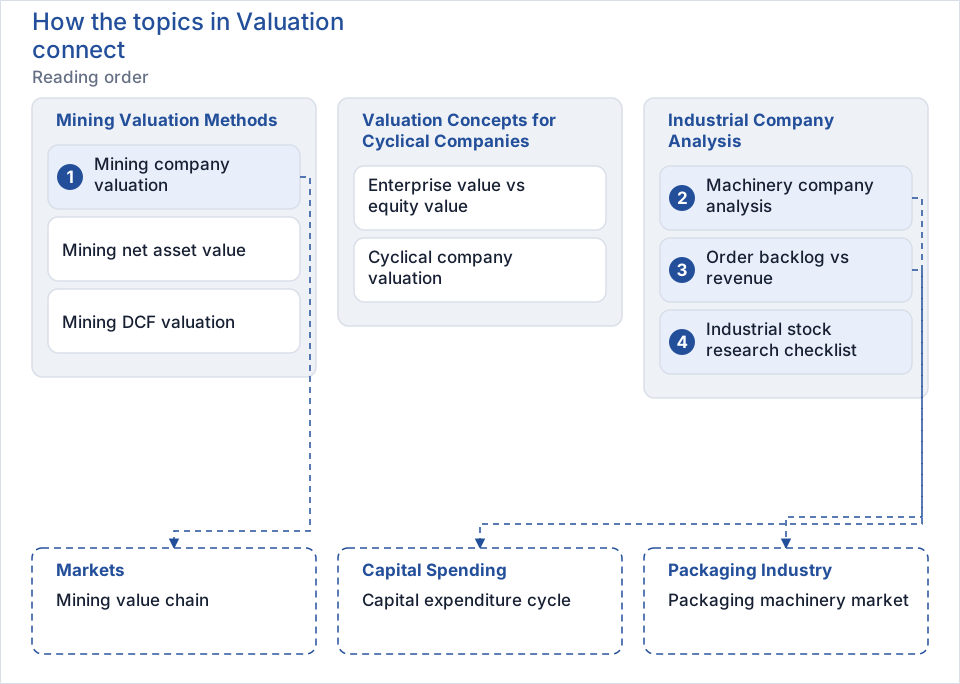
The section moves from valuation objects to valuation concepts to company analysis. The mining group covers the methods that fit each asset stage. The concepts group clarifies what value means and how cycles distort it. The industrial group applies disclosure reading to machinery businesses and ends with a general checklist. A good reading order starts with mining valuation, then machinery analysis, then the backlog article, and then the checklist. These topics lean on other sections as well: sector value chains in the resource and industrial markets section explain who earns what, capital spending explains why orders rise and fall, and the packaging industry research applies machinery company analysis to one equipment market.
Limits of the method
Valuation here is a research method and gives no advice. Worked examples use clearly labeled hypothetical figures, and nothing on this site suggests buying, selling or holding any security. The editorial policy describes how sources are checked and how limitations are stated, and every article ends with its own limitations section so that you can see what the method cannot tell you.