
Types of CapEx: Maintenance and Growth
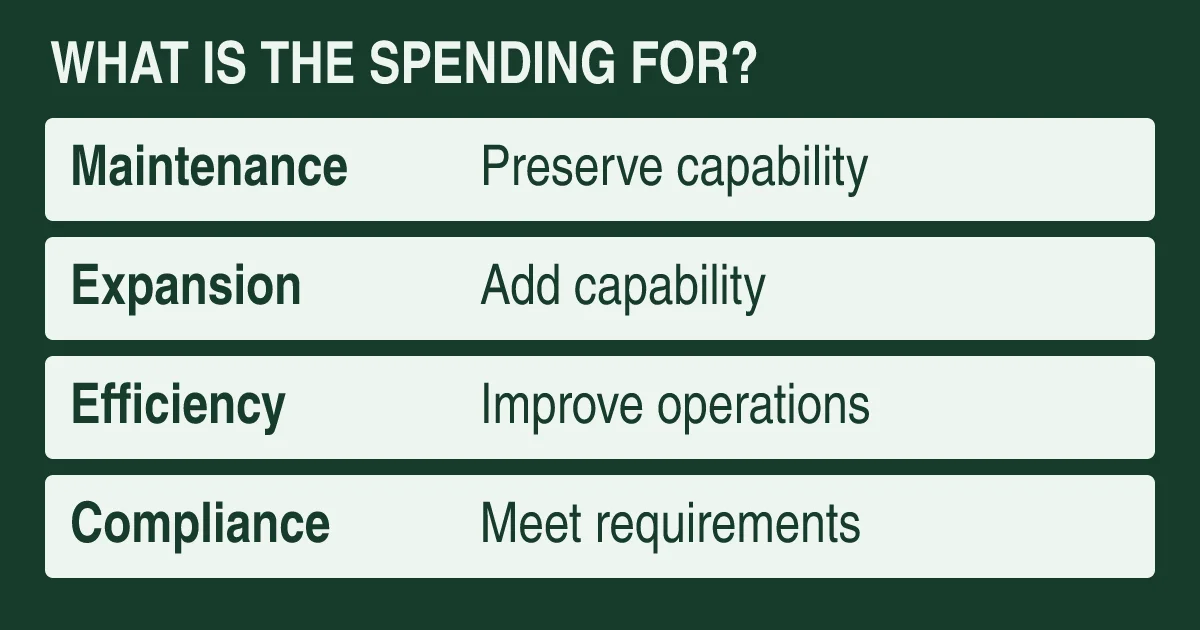
Calling all capital spending “growth” can make a company’s expansion plan look larger than the evidence supports. Separate spending intended to preserve existing capability from spending intended to add capability or improve economics, then keep the company’s own definitions beside any estimate you make.
Maintenance and growth are useful analytical categories, not a standard maintenance/growth split required by US GAAP or IFRS. A company may disclose its own categories; where it does not, a researcher’s allocation is an estimate. This guide explains the purposes behind industrial CapEx and how to identify them in documents. It does not decide whether a particular expense qualifies for capitalization.
| Research question | Record to keep | Interpretation limit |
|---|---|---|
| What is being preserved? | Existing asset or operating capability | Replacement need alone does not specify an accounting treatment |
| What is being added? | Proposed capacity, product or site | An announced project does not prove completed output |
| What is being improved? | Claimed cost or process benefit | Efficiency can support existing operations or future growth |
| What requirement is being met? | Compliance objective and project scope | Compliance can overlap other purposes |
| Who assigned the category? | Company definition or analyst rationale | Disclosed and estimated values are different evidence |
| Which total is being divided? | Period, perimeter and reconciliation | Different measures cannot be compared just because both say CapEx |
Keep accounting presentation separate from project purpose
Use one column for the reported measure and another for the purpose you are studying. A cash-flow classification does not itself tell you whether a project preserves or expands the business.
The IFRS Foundation’s IAS 7 overview describes operating, investing and financing cash flows. The SEC’s financial-statement guide illustrates machinery purchases as investing cash outflows and explains the separate role of management’s discussion. Neither framework turns the four purposes used below into a mandatory project taxonomy.
Keep the capitalization question separate. The existing CapEx and OpEx explainer discusses that neighboring distinction; this article begins with the capital-spending measure under review and asks what it is intended to achieve. Use the source directory to retain the underlying report rather than citing an untraceable chart.
Takeaway: Accounting presentation identifies the reported item; purpose classification is a separate research step.
Use four purposes without treating them as four exclusive boxes
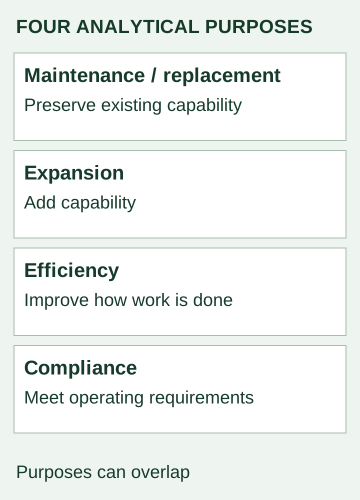
A practical industrial reading list is maintenance or replacement, expansion, efficiency improvement, and compliance. These are suggested analytical labels. Projects can serve several purposes, and a company’s own reporting terms may group them differently.
| Purpose | Illustrative project, not company data | Evidence that would help | Possible overlap |
|---|---|---|---|
| Maintenance or replacement | Replace worn machinery to preserve existing output | Existing capability and replacement scope | The replacement may also improve efficiency |
| Expansion | Add a production line or a new operating site | Added capability, project milestones and intended output | New facilities also need compliance work |
| Efficiency improvement | Automate handling to reduce a recurring process burden | Baseline process and the stated improvement | Could sustain competitiveness or support more output |
| Compliance | Install equipment to meet an applicable requirement | Requirement, affected operation and project scope | May be necessary to preserve existing operations |
The useful question is what would change if the project were not undertaken. Would current capability deteriorate, an expansion fail to occur, a cost-saving opportunity be missed, or an operating requirement remain unmet? Record the explanation rather than assigning a category from the equipment’s name.
For packaging-industry research, a replacement packing line could carry both maintenance and expansion objectives. Calling it “automation” does not settle which dominates. The capital-spending research framework places those project questions alongside broader investment conditions.
Common mistake: Adding four purpose totals together even though the same project appears in more than one. Use mutually exclusive amounts only when the allocation method supports them.
Takeaway: Use the four labels to ask better questions, and record overlap before adding amounts.
Read the company’s definition before comparing its split
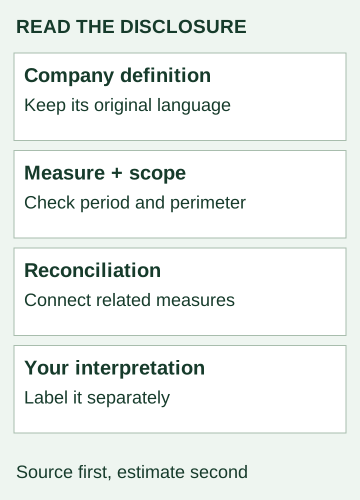
Preserve management’s wording and reporting boundary before translating it into your own model. “Growth,” “expansion,” “sustaining” and “maintenance” are not interchangeable across companies without checking their definitions.
For a concrete disclosure example, MPLX LP’s 2025 Annual Report and Form 10-K, printed page 66 (PDF page 80) describes growth capital as including projects expected to increase capacity, reduce operating expenses or increase long-term operating income. Its maintenance description includes replacing depreciated assets and maintaining existing operating capacity or related cash flows. Read the original Capital Expenditures section.
That example matters because cost reduction can fall within a company’s growth definition. It would be misleading to recategorize every efficiency project as maintenance without explaining the change. The same page provides a bridge from its growth-and-maintenance measure to additions to property, plant and equipment. The bridge and footnotes are part of the evidence, not optional detail.
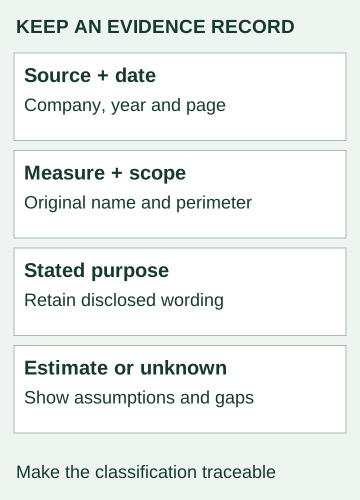
A research record should preserve the company name, reporting year, document page, exact measure label and your separate interpretation. The editorial methodology explains why source-backed statements and analytical judgments should remain distinguishable.
Takeaway: Compare definitions and reconciliations before comparing reported maintenance or growth amounts.
Classify mixed projects without inventing an allocation
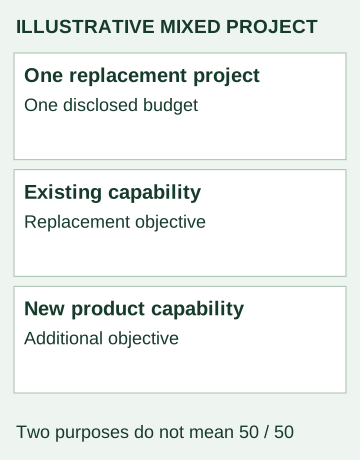
Describe the components when a project both replaces assets and changes capability. If the disclosure does not allocate the budget between them, retain an unallocated amount rather than manufacturing a precise split.
Consider an illustrative example only: a factory proposes replacing a worn production line with equipment that also supports a new product format. The source gives one project budget and describes both purposes, but provides no component allocation. A defensible entry is “replacement and new-product capability; allocation not disclosed.” It is not defensible to assume half is maintenance just because two purposes are mentioned.
Ask whether the company provides separate work packages, an existing-capability baseline, or a budget bridge. If those details are absent, state what would be needed to refine the estimate. Do not convert your uncertainty into a company-reported fact by copying the resulting number into a comparison table without a label.
| Evidence status | How to present it | What the reader can conclude |
|---|---|---|
| Company-disclosed classification | Preserve label, scope and citation | The company reports the project this way |
| Analyst estimate | Explain method, assumptions and unresolved inputs | The allocation depends on that method |
| Unallocated mixed purpose | Name the purposes and missing allocation | The split is not established by the available evidence |
The valuation research section addresses how assumptions enter a valuation. A classification here does not establish a project’s return or the value of the company’s securities.
Takeaway: An explicit unknown is more useful than an unsupported maintenance/growth percentage.
Build a comparable disclosure worksheet
Use a row for each disclosed measure or project, then retain the attributes needed to compare periods. This prevents a new definition or a changed group boundary from looking like a change in investment priorities.
A useful worksheet includes the company and period; document and page; original measure name; currency and units if amounts are recorded; reporting perimeter; actual expenditure versus a forecast or commitment; stated purpose; reconciliation; and your evidence status. Leave an explanation beside every adjustment.
Check whether two periods describe the same perimeter before discussing a trend. A newly included business or a changed treatment of reimbursements can change a reported measure without indicating more investment in the same assets. Identify the stated basis rather than assuming that similarly named totals are comparable.
In industrial market research, keep a company-specific statement distinct from an industry conclusion. One disclosed expansion project is evidence of that company’s plan; it is not a measured increase in an entire market’s spending. If a later filing changes the basis, update the worksheet and preserve the earlier source. The site’s correction process provides a route for documenting source-based changes to published research.
Common mistake: Treating the absence of a maintenance line as proof that maintenance spending is zero. The split may simply be undisclosed.
Takeaway: Compare the same measure, period basis and perimeter, and make every adjustment traceable.
Know when this classification does not answer the question
The four-purpose map is not a capitalization rule, a tax classification, an investment recommendation or a universal “four types of expenditure” framework. Public-finance categories and a company’s accounting policies answer different questions.
Sector guidance can add its own definitions. The World Gold Council’s AISC and AIC guidance explicitly describes those measures as non-GAAP and discusses management judgment in sustaining versus non-sustaining classifications. Its gold-mining framework should not be transferred wholesale to a manufacturing line.
An announced expansion may still face demand, execution or financing constraints. Classifying its purpose does not show that it will be completed or that its returns will exceed its cost. Keep those questions outside the classification conclusion and use the research-use disclaimer when interpreting the site’s educational material.
Takeaway: Classify the stated purpose, then investigate recognition, execution and value as separate questions.
Frequently asked questions
Can depreciation stand in for maintenance CapEx?
Only as an explicitly stated proxy whose limits you examine, not as an identity. The SEC explains depreciation as allocating asset cost across periods of use. That accounting charge does not establish the current cash needed to replace the installed assets. Check the assets, replacement timing and current project evidence before using it in an estimate; this guide endorses no universal conversion factor.
Why can an estimated maintenance amount come out negative?
If a positive-spending model calculates maintenance as total spending minus estimated growth, a negative result means estimated growth exceeds the total used. Check signs, periods, measure boundaries and the estimation assumptions. It does not establish that the business has “negative maintenance needs.” Preserve the failed reconciliation and revise the method instead of silently replacing the answer with zero.
Is working-capital investment the same as growth CapEx?
No. Working-capital changes and long-term asset spending are different inputs, even if both support expansion. Inventory needed for a new product should not automatically be relabeled as the maintenance/growth split of equipment spending. Keep the cash-flow scope explicit and consult the company’s statements; the SEC guide explains the separate operating and investing sections.
Should acquisitions be included in a CapEx measure?
Check the measure rather than assume. In the MPLX 2025 example, the narrative growth definition mentions acquisitions, while the table’s footnote excludes specified acquisitions from its total growth capital expenditure measure. The purpose description and numerical perimeter must both be read. A valuation model’s acquisition assumptions are a further decision, outside this classification guide.
Can I remove growth CapEx from a cash-flow forecast?
Not while leaving dependent benefits unexplained. If the forecast assumes output from a proposed expansion, show how that output would occur without the project spending. A “without expansion” scenario needs consistent operating assumptions as well as a different spending line. This is a modeling consistency check, not a recommendation to exclude or include a particular company’s spending.
Can site-level sustaining figures be added directly into a company comparison?
Check what is omitted at site level. The World Gold Council’s reporting FAQ 2 explains that site measures may exclude corporate costs and recommends company-level measures alongside them. Within that specific gold-mining guidance, retain the reconciliation and reporting basis. Do not treat an unadjusted site total as automatically comparable with a consolidated-company measure.
Methods and sources
SRP Blog Editorial Desk prepared this AI-assisted educational guide from the official sources listed below, checked October 7, 2026. No independent human review, company interview or investment return is claimed. The project examples and five illustrations are original illustrations. Company disclosure is attributed to MPLX LP, 2025, printed page 66; no company amounts are reproduced. Analyst classifications and estimates are not mandatory standardized GAAP/IFRS maintenance/growth disclosures.
The FAQ topics come from actual questions about depreciation as a proxy, negative estimated maintenance, working capital versus maintenance, acquisitions in CapEx and removing growth spending, plus the World Gold Council’s published site-level reporting question. Community posts establish the questions, not accounting rules or the answers above.
Continue the research
Related Research
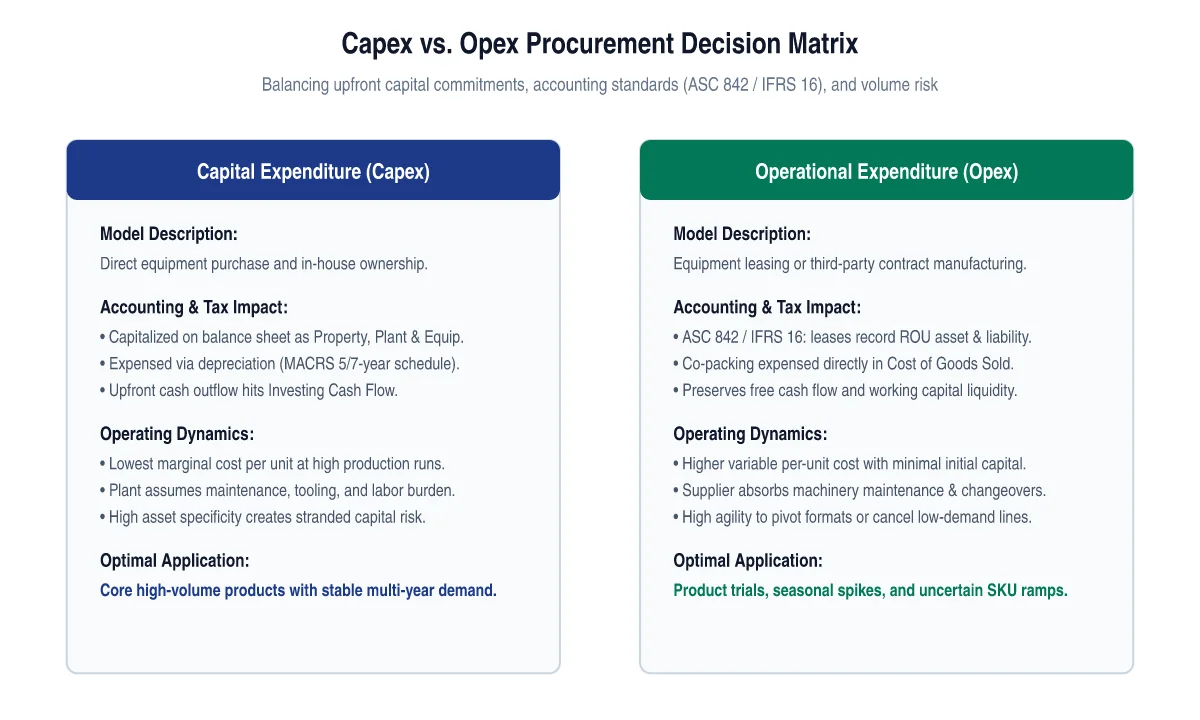
Capex vs Opex in Industrial Manufacturing and Machinery
How do industrial companies evaluate the trade-off between capital expenditure and operational expenditure when acquiring packaging and production capacity?
Sources & Data Notes
-
Company-specific definitions and reconciliation structure; no company amounts reproduced.
-
Gold-mining non-GAAP guidance, not a general industrial accounting standard.