
Book to Bill Ratio: Formula, Backlog Signal & Limits
Key Takeaways
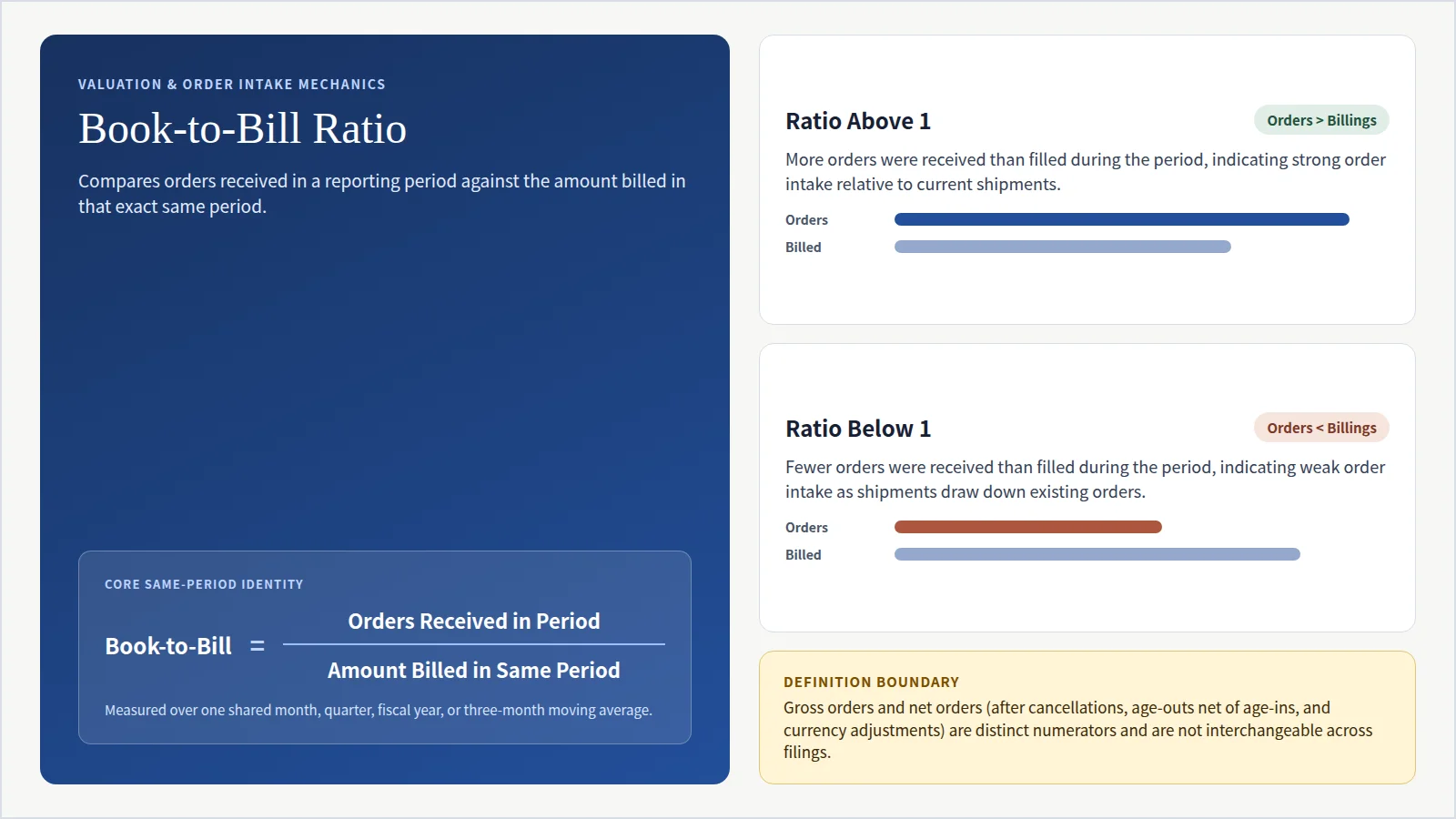
- The book-to-bill ratio divides orders received in a specific period by the amount billed in that same period, usually one month or one quarter.
- Gross orders and net orders are distinct numerators: Accuray divides gross orders by product revenue, whereas its net orders subtract cancellations, age-outs net of age-ins, and foreign exchange and other adjustments.
- There is no universal good book-to-bill level: orders and backlog are not defined by U.S. GAAP in Accuray's Form 10-K, backlog conversion into recognized revenue is not assured, and SEMI ended its monthly bookings series after December 2016.
Research Scope
- Regions
- United States SEC EDGAR company disclosures, Federal Reserve monetary policy reports, and North American and Japanese semiconductor equipment benchmarks.
- Period
- Monthly, three-month moving average, and annual book-to-bill series alongside fiscal 2024 and fiscal 2025 equipment disclosures.
- Industries
- Semiconductor manufacturing equipment, semiconductor devices, system sales and capital equipment, and industrial motors.
- Data objects
- Gross orders, net orders, cancellations, 30-month age-outs, age-ins, product revenue, net bookings, ending order backlog, and three-month moving average book-to-bill series.
The book-to-bill ratio divides orders received in a specific period by the amount billed in that same period. Above one, more orders were received than filled; below one, fewer orders were received than filled. Companies do not share one numerator: gross orders and net orders after cancellations, age-outs, and currency adjustments are not interchangeable.
What is the book-to-bill ratio formula?
In Wikipedia’s book-to-bill ratio entry, the metric, also called the BB ratio or BO/BI ratio, is the ratio of orders received to the amount billed for a specific period, usually one month or one quarter. Wikipedia notes that the ratio is widely used in the technology sector and especially in the semiconductor industry, where the semiconductor manufacturing equipment book-to-bill ratio is considered an important leading indicator of demand trends; for related company-disclosure methods, see our valuation research section.
Trade associations smooth single-month swings with three-month averages. Semiconductor Equipment and Materials International (SEMI) defined its equipment book-to-bill as the ratio of three-month moving averages of worldwide bookings and billings for North American-based semiconductor equipment manufacturers, following the U.S. Department of Commerce protocol to smooth natural volatility in billings. In SEMI’s September 2016 release, North America-based semiconductor equipment manufacturers posted a three-month average book-to-bill ratio of 1.05, with preliminary bookings of 1,604.1 and billings of 1,534.4 (in millions), meaning 105 worth of orders were received for every 100 of product billed for the month. SEMI noted that the data in that release were compiled without audit from data submitted directly by participants, and that the report tracked equipment used to manufacture semiconductor devices rather than the chips themselves. Wikipedia describes that SEMI report as based on confidential bookings and billings data for 22 equipment categories broken down into seven regions: North America, Japan, Europe, Taiwan, Korea, China, and Rest of World.
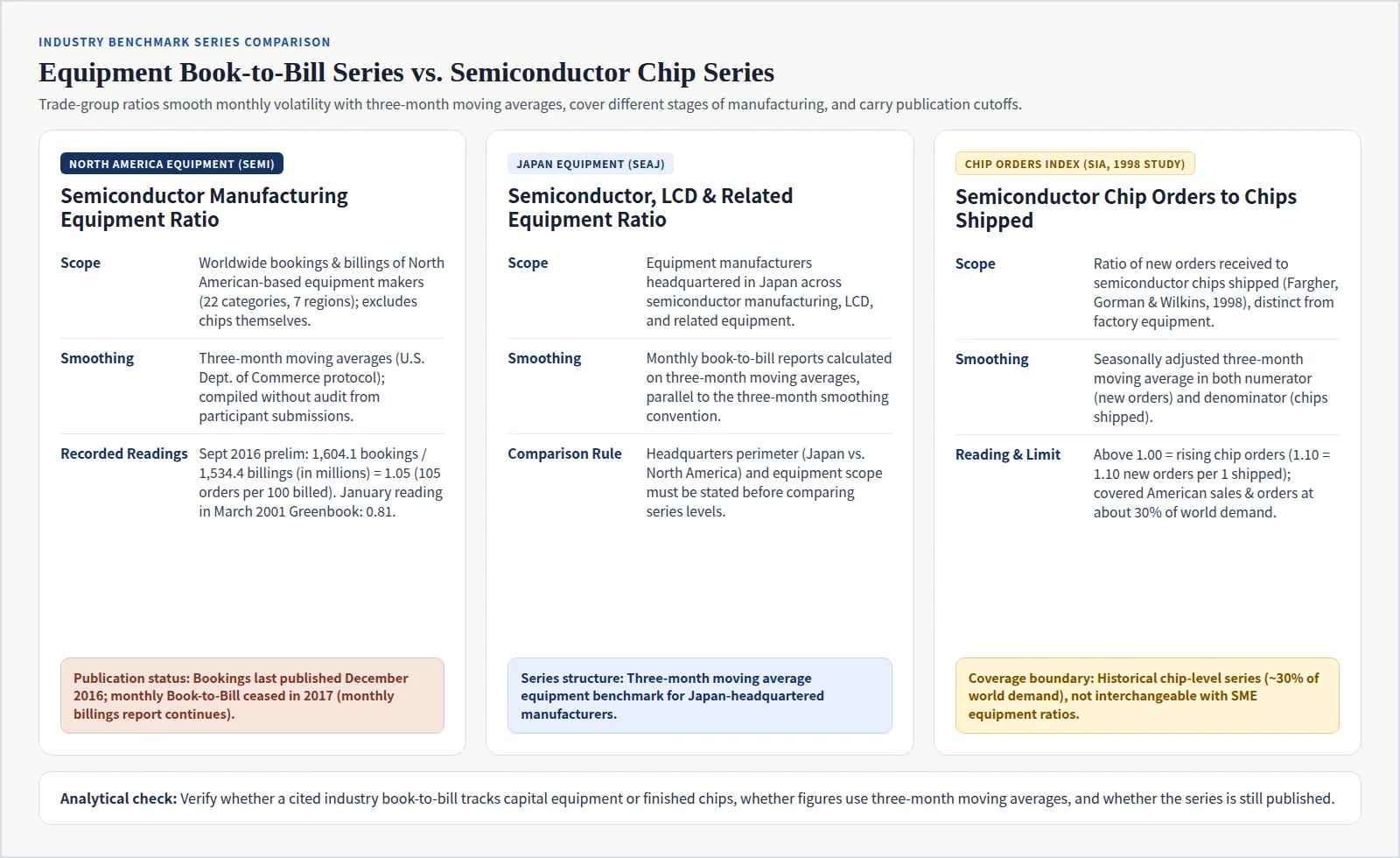
Although Wikipedia describes SEMI’s North American book-to-bill in the present tense, SEMI ceased publishing the monthly North America Book-to-Bill report in 2017 after the December 2016 release marked the last publication of bookings data, citing participant reporting changes that made order submissions unnecessary for their industry analysis. SEMI continues to publish a monthly billings report for North American equipment companies, while the Semiconductor Equipment Association of Japan (SEAJ) publishes monthly three-month moving average book-to-bill reports for semiconductor, LCD, and related equipment makers headquartered in Japan.
Which bookings number is the numerator?
Company filings do not use a single bookings definition in the numerator. In Accuray Incorporated’s Form 10-K for the fiscal year ended June 30, 2025, management defines its book-to-bill ratio as gross orders for the period divided by product revenue for the period. Gross orders are the sum of new orders recorded during the period, adjusted for revisions to existing orders during the period. By contrast, Accuray defines net orders as gross orders less cancellations, age-outs net of age-ins, and foreign exchange and other adjustments during the period.
Even the word “net” varies across issuers. In ASML’s US GAAP financial results exhibit, net bookings include all system sales orders and inflation-related adjustments for which written authorizations have been accepted, while the risk of order cancellations, delays, or push-outs is stated separately rather than subtracted in that sentence.
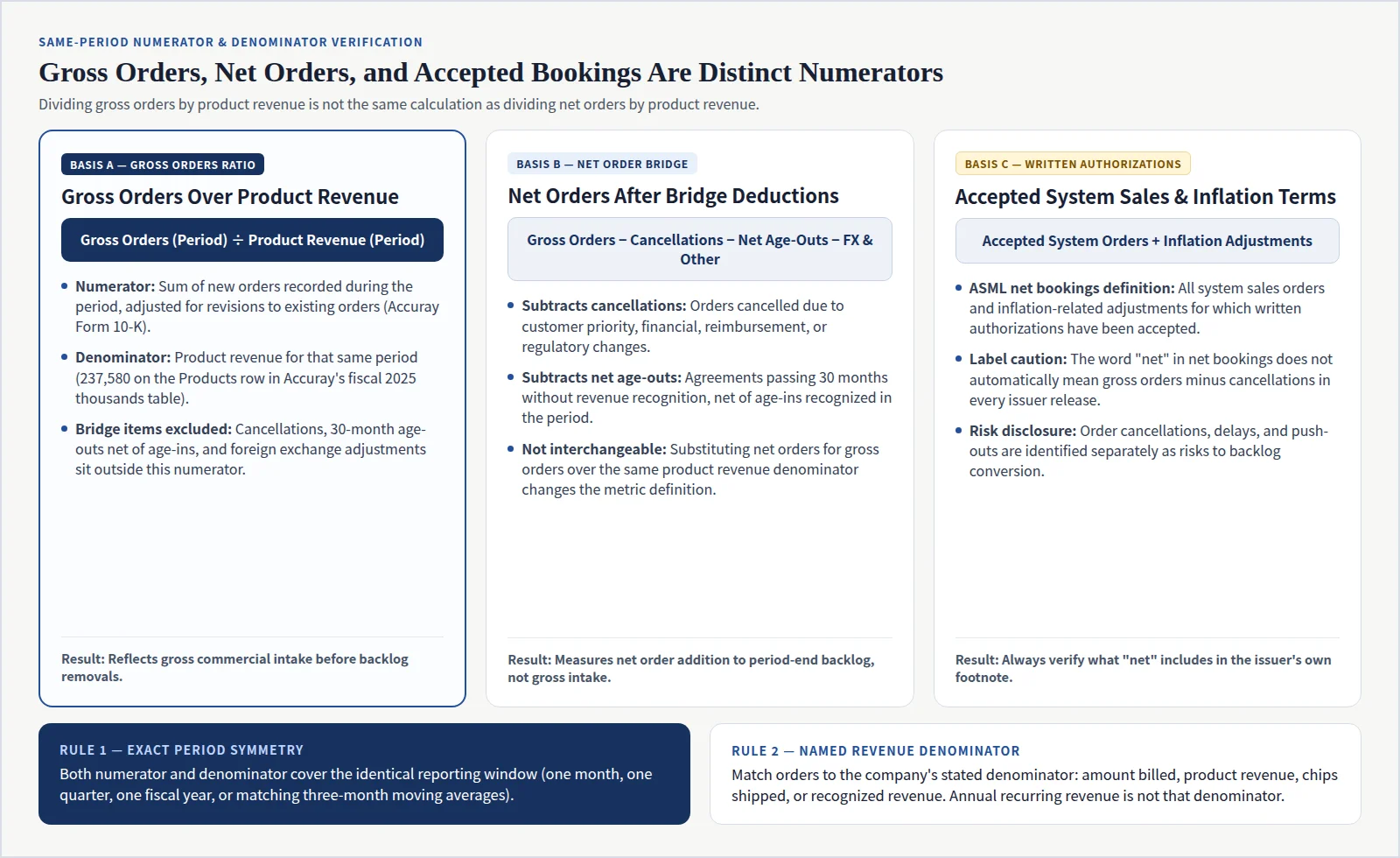
Bookings are also distinct from recognized revenue and subscription metrics. Bookings measure orders received, whereas the denominator is the amount billed, product revenue, chips shipped, or recognized revenue that the company or trade group names for the same period. None of the filings or industry series cited here uses annual recurring revenue as the book-to-bill denominator.
What is a good book-to-bill ratio?
There is no universal good book-to-bill number that applies across industries or across stages of a capital cycle. Under Wikipedia’s general definition, a ratio above one means more orders were received than filled, indicating strong demand, while a ratio below one indicates weak demand. Individual companies sometimes state higher internal benchmarks: Accuray states in its fiscal 2025 Form 10-K that a book-to-bill ratio greater than 1.2 indicates strong demand for its products, reporting 1.2 for the year ended June 30, 2025 compared with 1.5 for the year ended June 30, 2024. That 1.2 figure is Accuray’s own product benchmark, not a general threshold for other equipment makers.
A reading above parity does not remove commercial risk either. In the Federal Reserve Beige Book dated November 30, 2011, a contact in the industrial motor business reported a book-to-bill ratio of 1.07, so backlog was growing, yet still described himself as worried. When evaluating how order intake interacts with peak or trough earnings multiples across sectors, pair any single-period ratio with our guide to company valuation multiples by industry cyclicality.
What does a ratio above one indicate?
A book-to-bill ratio greater than 1 indicates that new orders recorded during the period exceeded the products billed or shipped in that same period. In SEMI’s September 2016 semiconductor equipment release, a three-month average ratio of 1.05 meant 105 worth of orders were received for every 100 of product billed for the month.
In their 1998 Trinity University study of the Semiconductor Industry Association (SIA) index, Neil L. Fargher, Larry R. Gorman, and Michael S. Wilkins examined a separate chip-level book-to-bill ratio defined as a seasonally adjusted three-month moving average of new orders received divided by a seasonally adjusted three-month moving average of chips shipped. By construction on that SIA index, ratios above 1.00 indicated increasing semiconductor chip orders (a ratio of 1.10 meant 1.10 in new orders received for every 1 of chips shipped), even though that American chip series accounted for only about 30 percent of world demand and tracked finished chips rather than manufacturing equipment. As the November 30, 2011 Beige Book contact at 1.07 illustrates, a single reading above one shows current order additions outpacing current billings, not assured future revenue.
What does a ratio below one signal?
A book-to-bill ratio below 1 signals that fewer orders were received during the period than were billed or shipped, so fulfillment is outpacing new order intake. On the SIA semiconductor chip series studied by Fargher, Gorman, and Wilkins (1998), ratios below 1.00 indicated decreasing semiconductor chip orders by construction.
In the Federal Reserve March 2001 Greenbook Part 2, staff cited Semiconductor Equipment and Materials International (SEMI) reporting that January shipments of equipment used to manufacture and assemble semiconductors outstripped new orders by nearly 20 percent; after peaking in August, the semiconductor equipment book-to-bill ratio fell to 0.81 in January, its lowest reading since 1998. That 0.81 figure records one historical month in which shipments exceeded incoming equipment orders rather than a permanent rule for every sub-parity period.
How do book-to-bill and backlog move together?
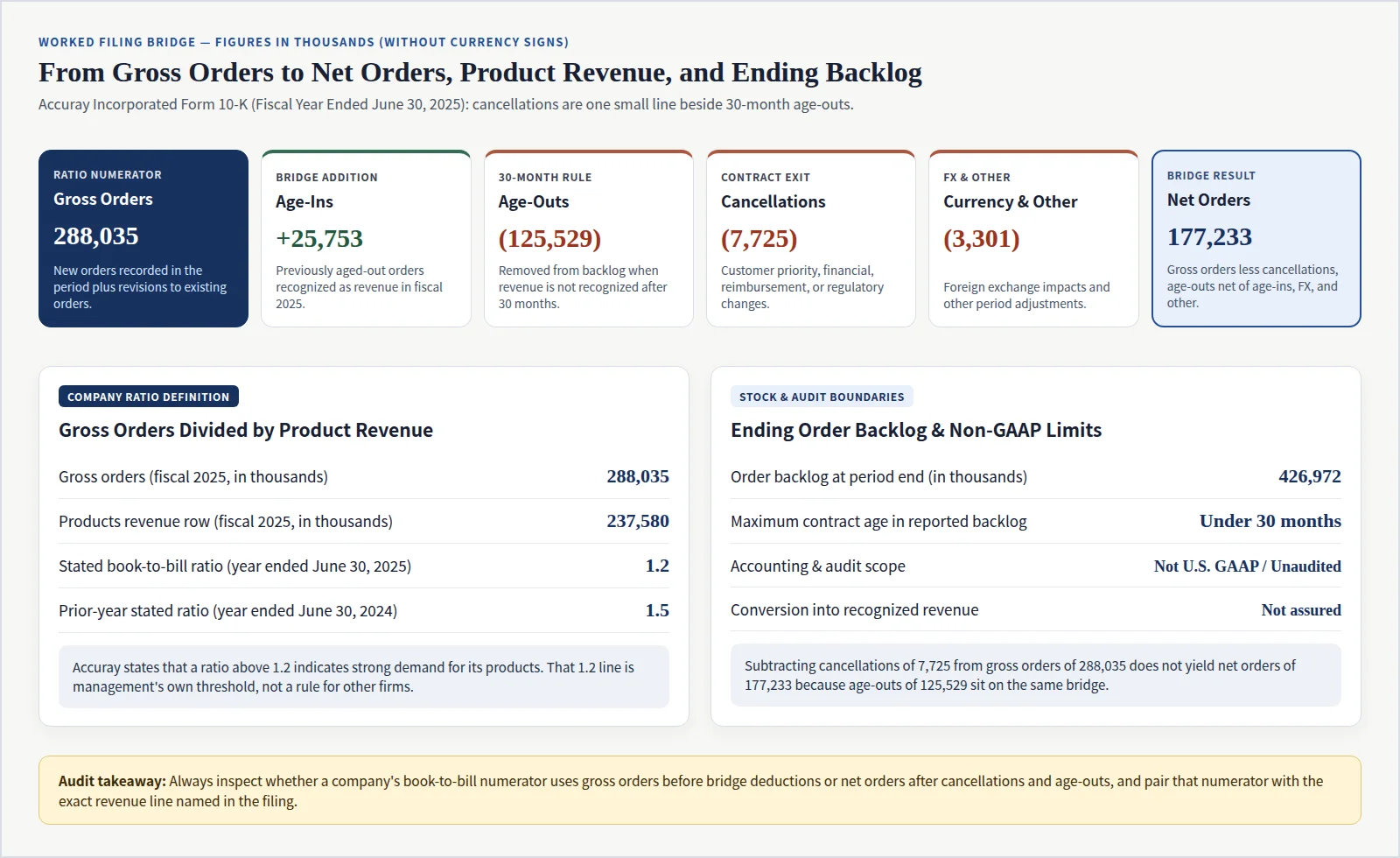
The book-to-bill ratio measures one period’s flow of orders against billings, whereas backlog measures the period-end stock of unfilled orders. ASML defines backlog as accumulated sales values for all system sales orders and inflation-related adjustments with accepted written authorizations not yet recorded in total net sales. Accuray cautions that orders and backlog are not defined by U.S. GAAP, lie outside its independent audit, and carry no assurance of converting into recognized revenue. Accuray keeps a system sale in backlog only while less than 30 months have passed since meeting backlog criteria, removes agreements without revenue after 30 months as aged-out (recording later revenue from aged-out agreements as age-ins), and notes that cancellations from customer priority, financial, reimbursement, or regulatory shifts remain outside its control.
Scroll horizontally to view all columns.
| Accuray fiscal 2025 line (in thousands, no currency sign) | Reported figure | Role in ratio and backlog bridge |
|---|---|---|
| Gross orders | 288,035 | Numerator of Accuray’s stated book-to-bill ratio |
| Age-ins | 25,753 | Previously aged-out orders recognized as revenue in fiscal 2025 |
| Age-outs | 125,529 | Removed after 30 months without revenue recognition |
| Cancellations | 7,725 | Cancelled orders; far smaller than 30-month age-outs |
| Currency impacts and other | 3,301 | Foreign exchange and other period adjustments |
| Net orders | 177,233 | Gross orders after cancellations, net age-outs, currency, and other |
| Order backlog at period end | 426,972 | Period-end backlog stock under the 30-month rule |
| Products revenue row | 237,580 | Denominator of stated 1.2 ratio (1.5 in fiscal 2024) |
Subtracting cancellations of 7,725 alone does not explain the gap between gross orders of 288,035 and net orders of 177,233 because age-outs reach 125,529. For full backlog-and-capex valuation modeling, see manufacturing company valuation, and for cash tied up during build cycles, see working capital in industrial capex cycles.
Book-to-bill definition audit checklist
Before comparing book-to-bill ratios across two equipment filings or citing an industry series, verify each disclosure item against the seven checks below.
Scroll horizontally to view all columns.
| Audit check | What to inspect in the filing or release | Grounded filing or benchmark rule |
|---|---|---|
| 1. Numerator basis (gross vs net) | Check whether the ratio uses gross orders, net orders after deductions, or accepted written authorizations | Accuray divides gross orders by product revenue; its net orders subtract bridge items, while ASML net bookings include accepted system orders and inflation adjustments |
| 2. Cancellations vs age-outs and FX | Separate direct contract cancellations from time-limit age-outs, age-ins, currency, and inflation lines | In Accuray’s fiscal 2025 thousands table, cancellations are 7,725 whereas 30-month age-outs are 125,529 and currency and other adjustments are 3,301 |
| 3. Denominator revenue line | Identify the exact billed or revenue line paired with orders | Sources name amount billed, product revenue (237,580 on Accuray’s fiscal 2025 Products row), or chips shipped rather than annual recurring revenue |
| 4. Same-period symmetry | Confirm numerator and denominator share one month, quarter, year, or moving-average window | General book-to-bill pairs one period’s orders with that period’s billings; SEMI, SEAJ, and the SIA chip index use three-month moving averages |
| 5. Non-GAAP and audit status | Check whether orders and backlog are defined by GAAP or covered by the financial audit | Accuray states orders and backlog are not defined by U.S. GAAP and are outside its independent audit; SEMI data were compiled without audit |
| 6. Backlog conversion and aging | Verify time cutoffs, cancellation triggers, and push-out risks | Accuray removes agreements without revenue after 30 months and states backlog conversion is not assured; ASML notes cancellation, delay, and push-out risk |
| 7. Industry series scope and cutoff date | Separate equipment series from chip series and verify publication status | SEMI tracked 22 equipment categories (not chips) and ended bookings publication after December 2016, ceasing the monthly Book-to-Bill report in 2017 |
Frequently asked questions
What is the book to bill ratio formula?
The book-to-bill ratio equals orders received in a period divided by the amount billed in that same period, usually one month or one quarter. Some issuers, such as Accuray, divide gross orders by product revenue, whereas net orders subtract cancellations, age-outs net of age-ins, and currency adjustments. Those numerators are not interchangeable.
What is a good book to bill ratio?
There is no single good number across companies. A ratio above one means more orders were received than filled during the period. Accuray states that a ratio above 1.2 indicates strong demand for its products, while a November 30, 2011 Beige Book contact at 1.07 still described himself as worried.
What does a book-to-bill ratio greater than 1 indicate?
A ratio greater than 1 indicates that orders received exceeded the amount billed or shipped in that period, such as SEMI’s September 2016 reading of 1.05 (105 worth of orders per 100 billed). By itself, a single period above one does not guarantee future recognized revenue.
What does a book-to-bill ratio less than 1 signal?
A ratio less than 1 signals that fewer orders were received than were filled during the period. In the March 2001 Federal Reserve Greenbook, January semiconductor equipment shipments outstripped new orders by nearly 20 percent and the equipment book-to-bill ratio stood at 0.81, recording one historical month rather than a full cycle.
How do book-to-bill and backlog work together?
Book-to-bill compares one period’s new order flow with that period’s billings, while backlog is the period-end stock of accepted orders not yet recorded in sales. In Accuray’s Form 10-K, orders and backlog are not U.S. GAAP measures, agreements age out after 30 months without revenue, and conversion into recognized revenue is not assured.
Are bookings the same as recognized revenue?
No. Bookings represent orders received, whereas the book-to-bill denominator is the amount billed, product revenue, chips shipped, or recognized revenue specified for the same period. None of the disclosures or industry benchmarks used here defines annual recurring revenue as the book-to-bill denominator.
Sources
- Wikipedia, Book-to-bill ratio.
- Accuray Incorporated, Form 10-K for the Fiscal Year Ended June 30, 2025 (SEC EDGAR).
- ASML Holding N.V., US GAAP Financial Results Press Release Exhibit (SEC EDGAR).
- Board of Governors of the Federal Reserve System, Beige Book, November 30, 2011 and Greenbook Part 2, March 2001 (PDF).
- Attribution-only industry and academic references (cited by name without links): Semiconductor Equipment and Materials International (SEMI), September 2016 North America Semiconductor Equipment Book-to-Bill Release and Billings Report Notice (three-month moving average definition, 1.05 preliminary reading, U.S. Department of Commerce smoothing protocol, and cessation of monthly Book-to-Bill reporting in 2017 following the December 2016 bookings release); and Neil L. Fargher, Larry R. Gorman, and Michael S. Wilkins (1998), Timely Industry Information as an Assurance Service: Evidence on the Information Content of the Book-to-Bill Ratio, Trinity University / Auditing: A Journal of Practice & Theory (Semiconductor Industry Association chip-level book-to-bill series and 30 percent world-demand boundary).
Continue the research
Related Research
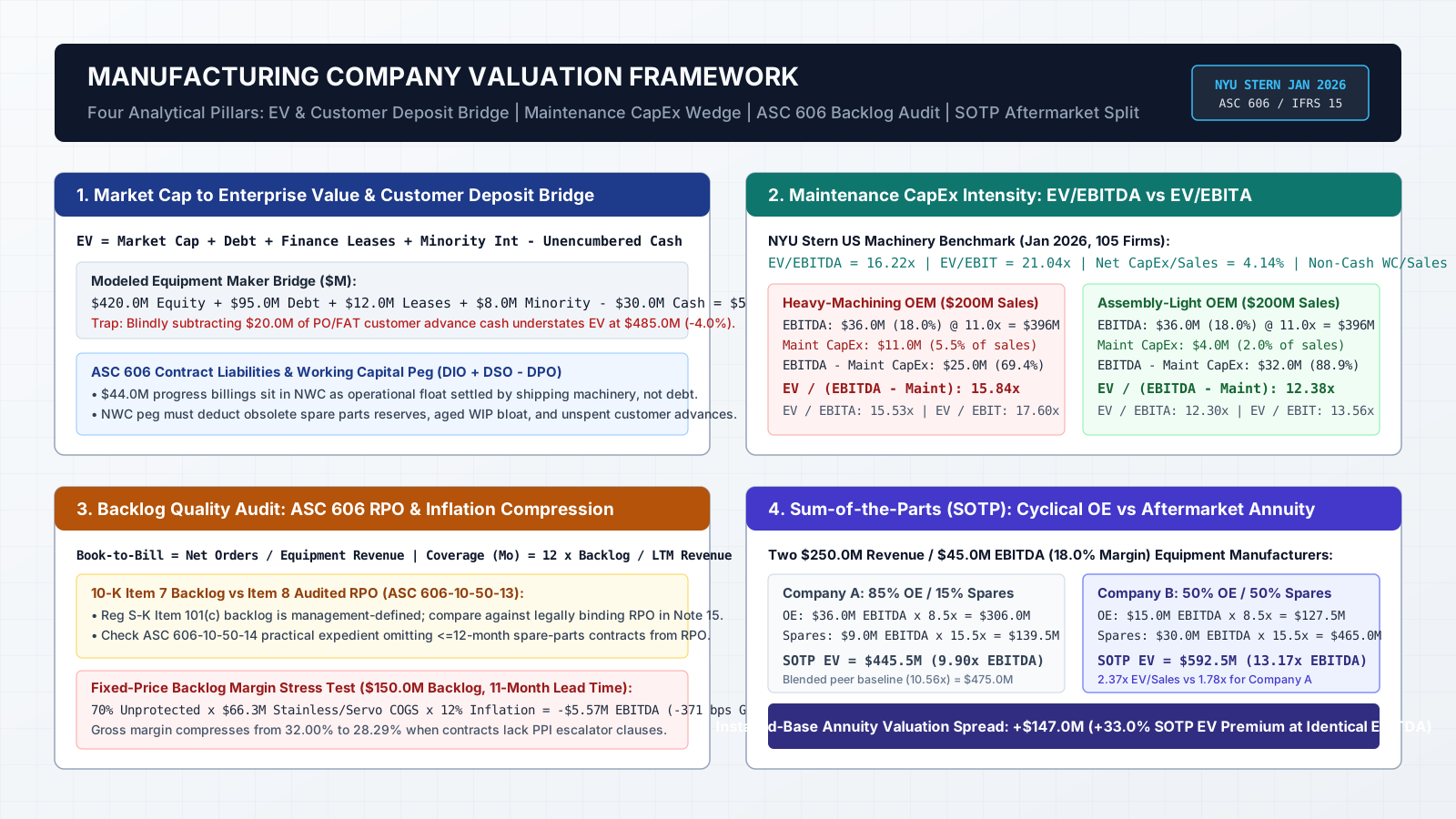
Manufacturing Company Valuation: Backlog Quality, Capex Intensity & Working Capital Adjustments
How do maintenance capital expenditure intensity, ASC 606 contract liabilities, backlog quality, and aftermarket revenue mix change a manufacturing company valuation?

Industry valuation multiples and the cycle year
When does an industry EV/EBITDA hide the cycle year and the cash spent to keep that EBITDA?

Working Capital in Industrial Capex Cycles: 10-K Cash Flow Statement Bridges and Customer Deposits
How should you reconcile working capital and capital spending in an industrial company filing?
Sources & Data Notes
- September 2016 North America Semiconductor Equipment Book-to-Bill Release and Billings Report Notice
- Timely Industry Information as an Assurance Service: Evidence on the Information Content of the Book-to-Bill Ratio