
ARO Accounting: Liability Recognition, Accretion, and Settlement Rules
Key Takeaways
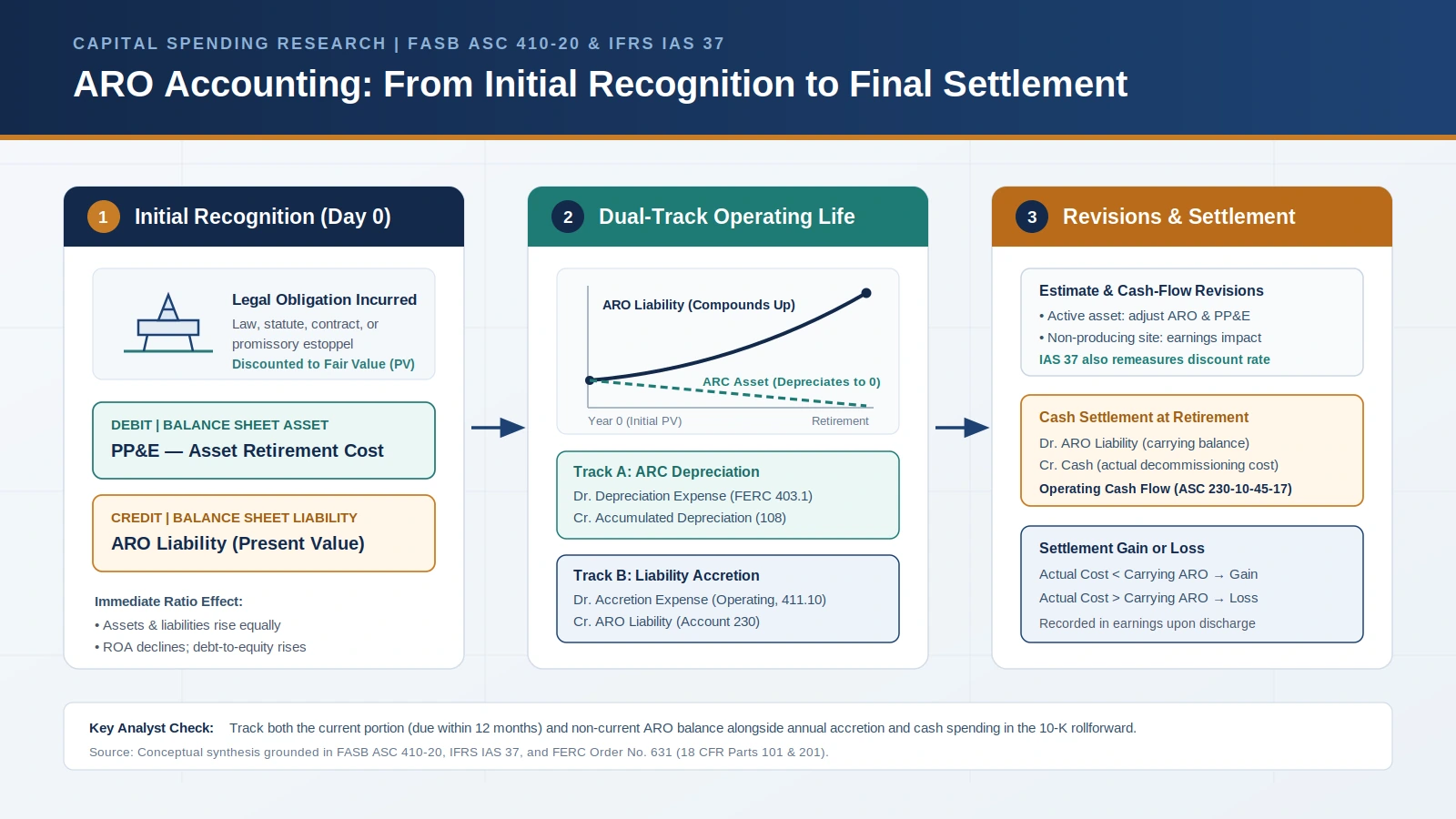
- Under US GAAP (FASB ASC Topic 410-20, formerly SFAS 143), an ARO liability is recognized at fair value when a legal retirement obligation is incurred, with an equal Asset Retirement Cost (ARC) capitalized into the carrying amount of PP&E.
- After initial recognition, ARO accounting runs two separate tracks: the capitalized ARC depreciates over the asset's useful life while the ARO liability compounds upward through operating accretion expense.
- Estimate revisions adjust both the ARO liability and PP&E for producing assets, whereas estimate changes for non-producing sites hit earnings immediately as impairment or reclamation adjustments.
- Under ASC 410-20-45-3 and ASC 230-10-45-17, cash paid to settle an ARO is generally classified in operating cash flows, and any variance against the carrying liability creates a settlement gain or loss.
Research Scope
- Regions
- United States (US GAAP and FERC); comparative reference to IFRS IAS 37
- Period
- Accounting framework explainer with 2023–2025 Form 10-K disclosures (filed February 2026)
- Industries
- Oil and gas extraction, metals and gold mining, regulated electric and pipeline utilities
- Data objects
- Balance sheet liabilities, PP&E asset retirement costs, operating accretion expense, 10-K ARO rollforwards
ARO accounting records the present value of a legally required asset retirement cost when the obligation is incurred, booking both a balance-sheet liability and an equal Asset Retirement Cost inside property, plant, and equipment. Over the asset’s useful life, the capitalized cost depreciates while the liability compounds through operating accretion expense until cash settlement.
What does asset retirement obligation mean under US GAAP and IFRS?
An asset retirement obligation (ARO) is a legal obligation associated with retiring a tangible long-lived asset where settlement timing or method may depend on a future event outside the company’s control. Under US GAAP, ARO accounting is governed by SFAS 143, codified as FASB ASC Topic 410-20, whereas IFRS entities apply IAS 37 and classify AROs as provisions.
Legal enforceability defines the scope boundary. Under FERC Order No. 631, which amended 18 CFR Parts 35, 101, 154, 201, 346, and 352 under Docket No. RM02-7-000 effective May 21, 2003, a binding ARO can arise from an existing or enacted law, statute, ordinance, written or oral contract, or legal construction under the doctrine of promissory estoppel. Removal costs that do not qualify as legal obligations fall outside ARO accounting scope, and ARO rules do not cover unplanned cleanup costs caused by an accident.
Scroll horizontally to view all columns.
| Accounting Dimension | US GAAP (ASC Topic 410-20 / SFAS 143) | IFRS (IAS 37) | FERC Order No. 631 (18 CFR Parts 101 & 201) |
|---|---|---|---|
| Primary balance sheet label | Asset retirement obligation (current and long-term portions) | Provisions (decommissioning or restoration liabilities) | Account 230, Asset retirement obligations |
| Initial measurement basis | Fair value (present value of expected retirement costs at inception) | Present value of expected settlement outflows | Fair value in the period the legal obligation is incurred |
| Discount rate treatment | Entity credit-adjusted risk-free rate locked at each layer | Regularly recalculated to reflect current market conditions | Aligns with SFAS 143 general-purpose SEC reporting |
| Asset side recognition | Asset Retirement Cost capitalized into related PP&E | Capitalized into related property, plant, and equipment | Charged to primary plant accounts as integral plant cost |
| Unplanned accident cleanup | Excluded from ARO scope | Assessed separately under environmental provisions | Non-legal removal costs excluded from ARO rule |
What is an ARO on the balance sheet, and how does it affect ratios?
On the balance sheet, an ARO appears on both sides at inception: a liability equal to the present value of expected future retirement costs and an equal Asset Retirement Cost (ARC) added to the carrying value of the related physical asset. Expanding assets and liabilities equally lowers return on assets and raises the debt-to-equity ratio.
Under FERC regulatory principles consistent with general-purpose SEC reporting, asset retirement costs are treated as an integral part of the specific physical asset that creates the obligation rather than as a separate standalone asset. Companies also do not recognize interest during construction on capitalized asset retirement costs for carrier or noncarrier property.
On the liability side, public filings split total obligations between amounts due within one year and long-term obligations. For example, ConocoPhillips’s 2025 Form 10-K places the current portion of AROs and accrued environmental costs inside Other accruals on the balance sheet, while Newmont’s 2025 Form 10-K reports current reclamation obligations inside Other current liabilities and non-current balances in Reclamation and remediation liabilities. To keep capital spending boundaries clear when analyzing PP&E additions, review how CapEx vs OpEx in industrial manufacturing separates upfront asset capitalization from period operating costs.
What are the initial and subsequent ARO accounting journal entries?
ARO accounting entries follow a four-stage ledger sequence: capitalizing the initial present value into PP&E and the ARO liability, recording annual ARC depreciation over the asset’s useful life, compounding the liability through operating accretion expense, and clearing the liability against cash at settlement with any variance booked as a gain or loss.
In general-purpose shareholder and SEC financial statements, companies separately report the ARO liability, capitalize asset retirement costs, charge earnings for depreciation of the capitalized cost, and charge operating expense for accretion of the liability. FERC Order No. 631 maps these entries to specific Uniform System of Accounts ledgers for regulated electric and natural gas utilities, illustrating the exact double-entry flow:
Scroll horizontally to view all columns.
| Lifecycle Event | Debit Entry | Credit Entry | Financial Statement Effect |
|---|---|---|---|
| Initial recognition (at installation or acquisition) | Related PP&E / Utility Plant Account (ARC) | ARO Liability (FERC Account 230) | Assets and liabilities increase equally at present value; no day-one earnings impact |
| Periodic ARC depreciation | Depreciation Expense for ARC (FERC Account 403.1) | Accumulated Depreciation (FERC Account 108) | Reduces operating earnings linearly or systematically over asset useful life |
| Periodic liability accretion | Accretion Expense (Operating, FERC Account 411.10) | ARO Liability (FERC Account 230) | Non-cash operating expense compounds the liability balance each period |
| Estimate revision (active asset) | PP&E (upward) or ARO Liability (downward) | ARO Liability (upward) or PP&E (downward) | Adjusts both carrying liability and depreciable PP&E prospectively |
| Final settlement at retirement | ARO Liability (carrying balance; plus Loss if over) | Cash paid (plus Gain if actual cost is below carrying balance) | Operating cash outflow; settlement variance flows to earnings |
How does accretion expense increase the ARO liability over time?
Accretion expense measures and incorporates changes caused by the passage of time into the carrying amount of an ARO liability under ASC 410-20-45-1. Because the initial liability is discounted to present value, each period’s accretion multiplies the beginning liability balance by the discount rate under the interest method, compounding the obligation toward its full future settlement cost.
Unlike routine depreciation, which spreads the smaller initial present value evenly over the asset’s life, accretion expense grows larger every year as the liability balance compounds. Both depreciation and accretion reduce operating income, yet neither requires cash outflow until actual decommissioning begins.
Worked 40-year ARO accounting example
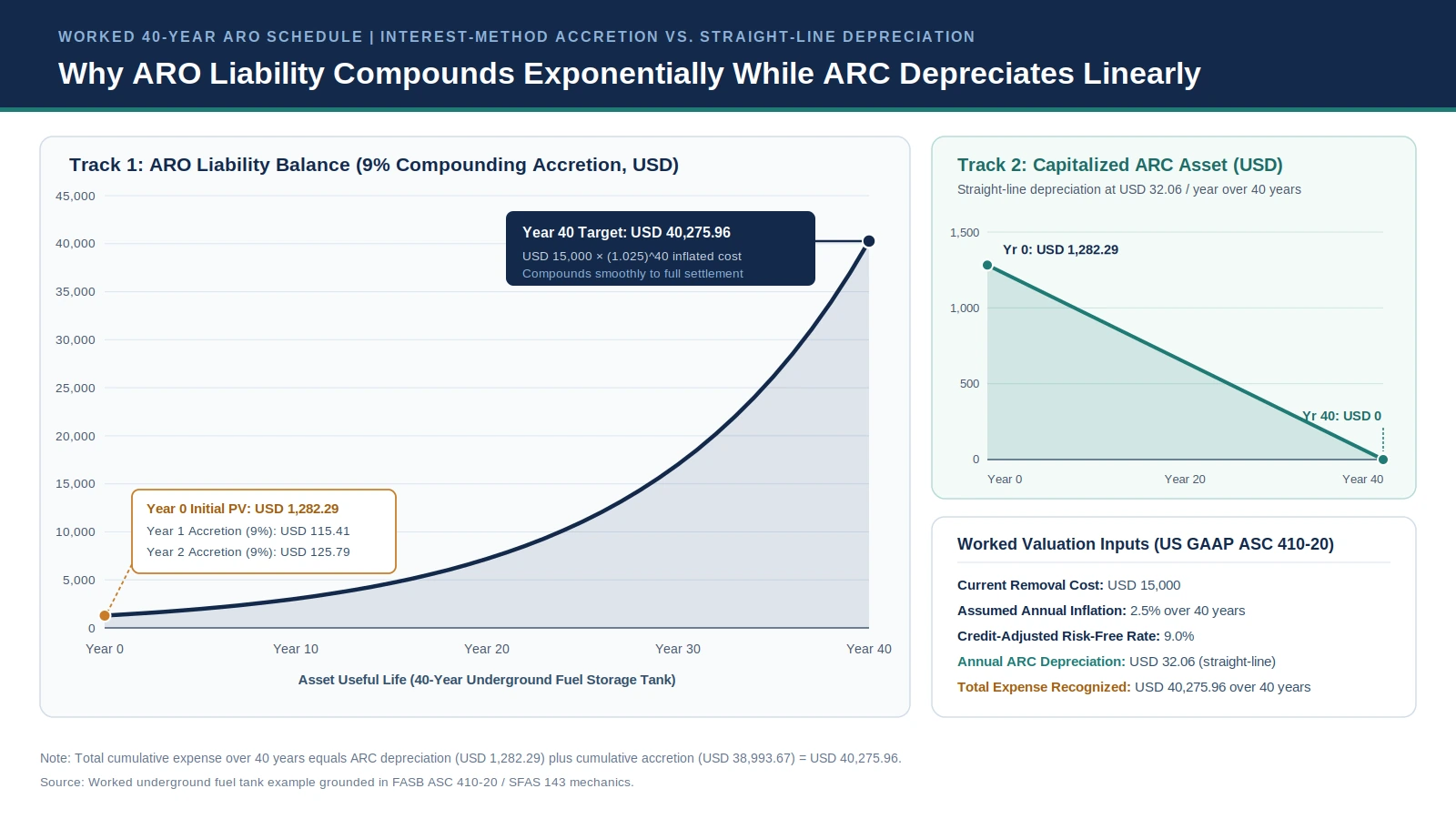
The standard underground fuel storage tank example shows why the asset and liability tracks diverge sharply over long asset lives. Assume a company installs underground fuel tanks with a 40-year useful life, a current removal cost of 15,000 U.S. dollars, expected annual cost inflation of 2.5 percent, and a credit-adjusted risk-free borrowing rate of 9 percent.
- Inflated future settlement cost: Compounding 15,000 U.S. dollars by 1.025 over 40 years produces an estimated future removal cost of 40,275.96 U.S. dollars.
- Initial present value recognition: Discounting 40,275.96 U.S. dollars by 1.09 over 40 years yields an initial present value of 1,282.29 U.S. dollars. At installation, the company records both a capitalized ARC asset and an ARO liability of 1,282.29 U.S. dollars.
- Annual ARC depreciation: Depreciating 1,282.29 U.S. dollars straight-line over 40 years generates a constant depreciation charge of 32.06 U.S. dollars per year until the asset reaches zero.
- Compounding accretion expense: Applying the 9 percent interest method to the ARO liability produces accretion expense of 115.41 U.S. dollars in Year 1 and 125.79 U.S. dollars in Year 2, growing the balance steadily to 40,275.96 U.S. dollars by Year 40.
Scroll horizontally to view all columns.
| Schedule Metric | Worked Example Value (USD) | Basis / Accounting Rule |
|---|---|---|
| Current removal cost at Year 0 | 15,000.00 | Uninflated baseline decommissioning estimate |
| Estimated future cost at Year 40 | 40,275.96 | Compounded at 2.5 percent annual inflation over 40 years |
| Initial ARC asset and ARO liability | 1,282.29 | Present value discounted at 9 percent credit-adjusted risk-free rate |
| Annual ARC depreciation (Years 1–40) | 32.06 | Straight-line amortization over 40-year useful life |
| Year 1 accretion expense | 115.41 | Interest method at 9 percent on Year 0 carrying liability |
| Year 2 accretion expense | 125.79 | Interest method at 9 percent on Year 1 accreted balance |
| Target ARO liability at Year 40 | 40,275.96 | Matches estimated future settlement outflow before final variance |
How do ARO accounting rules handle cost estimate revisions and settlement?
When estimated settlement cash flows or timing change on an active asset, ARO accounting adjusts both the carrying liability and the related PP&E balance prospectively. When estimates change for assets that are no longer producing, the adjustment flows directly into earnings as impairment or reclamation expense rather than increasing a retired asset’s book value.
Under ASC 410-20-50-1(c)(4), public issuers disclose increases or decreases arising from revised cash-flow amounts or timing in a dedicated rollforward table. To support those adjustments, FERC Order No. 631 requires separate subsidiary records for every ARO tracking the initial liability and ARC, incremental layers added in later periods, cumulative accretion, subsequent measurement revisions, depreciation, and the final settlement date and payment.
Settlement cash flows and US GAAP vs. IFRS remeasurement
When retirement work is performed, actual expenses incurred debit the ARO liability, and any difference between the carrying liability and actual cash paid is recognized in earnings as a settlement gain or loss. Under ASC 410-20-45-3 and ASC 230-10-45-17, cash paid to settle an asset retirement obligation is generally classified in the operating section of the statement of cash flows rather than in investing CapEx.
Cross-border comparisons require one additional check. Under IFRS IAS 37, companies regularly recalculate the discount rate during the asset’s life to reflect current market conditions, remeasuring the present value and adjusting both the asset and liability whenever market rates move. Under US GAAP, historical layers remain accreted at their original credit-adjusted risk-free rate unless revised cash flows create an updated measurement layer.
How does ARO accounting apply to oil, gas, and mining companies?
Oil, gas, and mining issuers carry multi-billion-dollar AROs because federal, state, and international laws mandate well plugging, offshore platform removal, pipeline dismantling, and mine-site reclamation after production ends. Missing the ARO footnote causes analysts to overlook recurring non-cash accretion expense and steep late-life operating cash outflows during field abandonment or mine closure.
In upstream petroleum, ConocoPhillips reports that its largest individual AROs cover plugging and abandonment of wells, removal and disposal of offshore platforms worldwide, and production facilities and pipelines in Alaska. In metals mining, Newmont and Freeport-McMoRan carry multi-billion-dollar closure and reclamation liabilities that can swing sharply when water-management plans or tailings-facility assessments change. For sector context on how upstream spending and technical reporting interact with cash generation, see oil company profits and CapEx and mining technical disclosure standards.
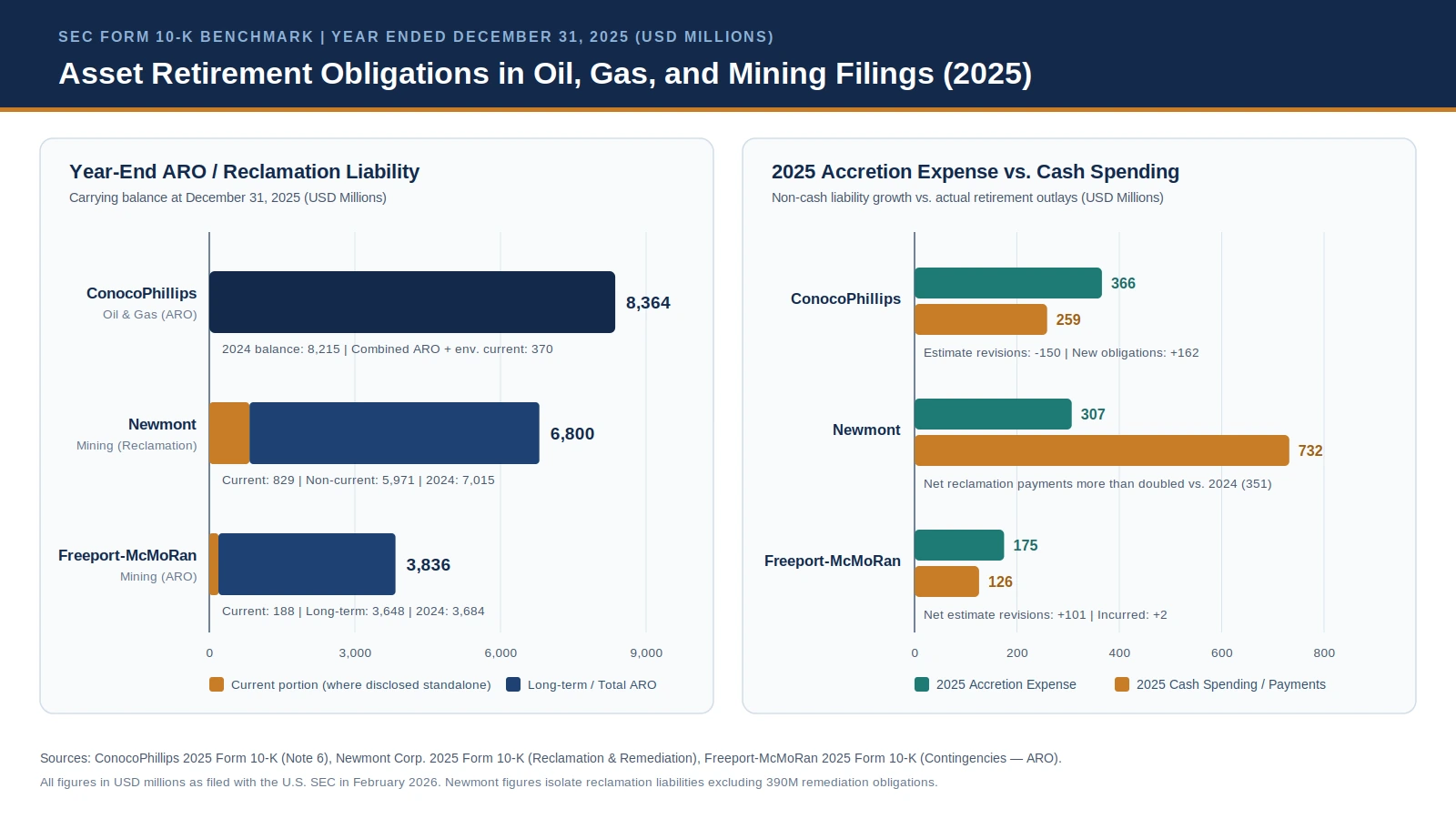
Comparing three major 2025 SEC Form 10-K rollforwards (filed in February 2026) demonstrates how liability scale, accretion, revisions, and actual cash spending diverge across resource companies:
Scroll horizontally to view all columns.
| 2025 Form 10-K ARO Metric (USD Millions) | ConocoPhillips (Oil & Gas — ARO) | Newmont (Mining — Reclamation) | Freeport-McMoRan (Mining — ARO) |
|---|---|---|---|
| Beginning balance (Jan. 1, 2025) | 8,215 | 7,015 | 3,684 |
| Accretion expense (2025 / 2024) | 366 / 319 | 307 / 365 | 175 / 154 |
| Cash spending / net payments (2025 / 2024) | 259 / 182 | 732 / 351 | 126 / 122 |
| Estimate revisions / additions in 2025 | Downward 150 revisions; 162 new obligations | 223 additions, estimate changes, and other | 101 net revisions; 2 liabilities incurred |
| Ending balance (Dec. 31, 2025) | 8,364 | 6,800 | 3,836 |
| Current portion at Dec. 31, 2025 | 370 (combined ARO and environmental) | 829 (reclamation current) | 188 (ARO current) |
| Long-term portion at Dec. 31, 2025 | 8,214 (combined ARO and environmental) | 5,971 (reclamation non-current) | 3,648 (ARO long-term) |
Two details in these filings stand out for financial analysts. First, cash settlement spending can accelerate far beyond annual accretion when major sites enter active closure: Newmont’s net reclamation payments more than doubled from 351 million dollars in 2024 to 732 million dollars in 2025, exceeding its 307 million dollars of 2025 reclamation accretion. Second, non-operating site updates hit the income statement immediately: at non-operating portions of Newmont’s Yanacocha site, updated cost estimates reduced reclamation expense by 192 million dollars in 2025 and 136 million dollars in 2024 after a 1,101 million dollar upward water-management charge in 2023. Meanwhile, ConocoPhillips’s 2025 rollforward also reflected 186 million dollars of property dispositions and 216 million dollars of foreign currency translation, while Freeport-McMoRan’s 2025 Form 10-K recorded 635 million dollars of net upward revisions in 2024 followed by 101 million dollars in 2025.
Form 10-K ARO footnote checklist for oil, gas, and mining research
Use these six checks when reviewing a resource company’s annual ARO or reclamation note alongside the capital spending research hub:
Scroll horizontally to view all columns.
| Checklist Item | What to Extract from the 10-K Footnote | Why It Matters for Cash Flow and Leverage |
|---|---|---|
| Current vs. long-term balance split | Separate current ARO inside Other accruals or Other current liabilities from non-current ARO | Current balances indicate near-term cash retirement outlays due within 12 months |
| Multi-year accretion trend | Compare annual accretion expense across three years against total ARO balance | Shows the non-cash operating drag compounding the liability even without new drilling or mining |
| Settlement spending vs. accretion | Track actual cash spending or net payments against operating cash flow | Under ASC 230-10-45-17, retirement spending reduces operating cash flow rather than investing CapEx |
| Non-producing site adjustments | Identify estimate revisions recorded directly to impairment or reclamation expense | Signals escalating closure liabilities on assets with no remaining revenue or economic value |
| Acquisitions, dispositions, and FX | Separate asset sales, acquisitions, and currency translation from organic revisions | Prevents mistaking portfolio divestitures or FX moves for lower unit decommissioning costs |
| Restricted funding and pledges | Check restricted cash and legally pledged investments (such as Newmont’s 33 million restricted cash and 13 million pledged investments at year-end 2025) | Reveals how much of the ARO is pre-funded versus funded from future general operating cash flows |
Frequently asked questions
What is the difference between an ARO and environmental remediation liabilities?
An ARO covers legal obligations tied to retiring a tangible long-lived asset from normal operations, acquisition, or construction, such as plugging oil wells or reclaiming mine pits. Environmental remediation liabilities cover unplanned cleanup costs from accidents or contamination, which fall outside ARO accounting scope and are tracked separately in company footnotes.
Is ARO accretion expense recorded as interest expense or operating expense?
Under US GAAP (ASC 410-20-45-1) and FERC Order No. 631 (Account 411.10), accretion expense is classified as an operating expense rather than financing interest expense. It reflects the passage-of-time increase in the discounted retirement liability and reduces operating income alongside ARC depreciation.
Where do ARO settlement payments appear on the statement of cash flows?
Under ASC 410-20-45-3 and ASC 230-10-45-17, cash paid to settle an asset retirement obligation is generally included in the operating section of the statement of cash flows. Analysts modeling free cash flow should verify that rising decommissioning cash outflows are captured in operating cash flow rather than omitted as non-operating items.
What happens when an ARO cost estimate changes after an asset stops producing?
When an asset is still operating, revised retirement cost estimates adjust both the ARO liability and the related PP&E carrying value prospectively. When an asset is no longer producing and has no expected substantive economic value, estimate increases or decreases hit the income statement immediately as impairment or reclamation adjustments.
How does IFRS IAS 37 differ from US GAAP ASC 410-20 for ARO accounting?
Under IFRS IAS 37, asset retirement obligations are called provisions and the discount rate is regularly recalculated to reflect current market conditions, adjusting both the asset and liability by the resulting present value difference. Under US GAAP ASC 410-20, historical obligation layers continue accreting using their credit-adjusted risk-free rate.
Continue the research
Related Research
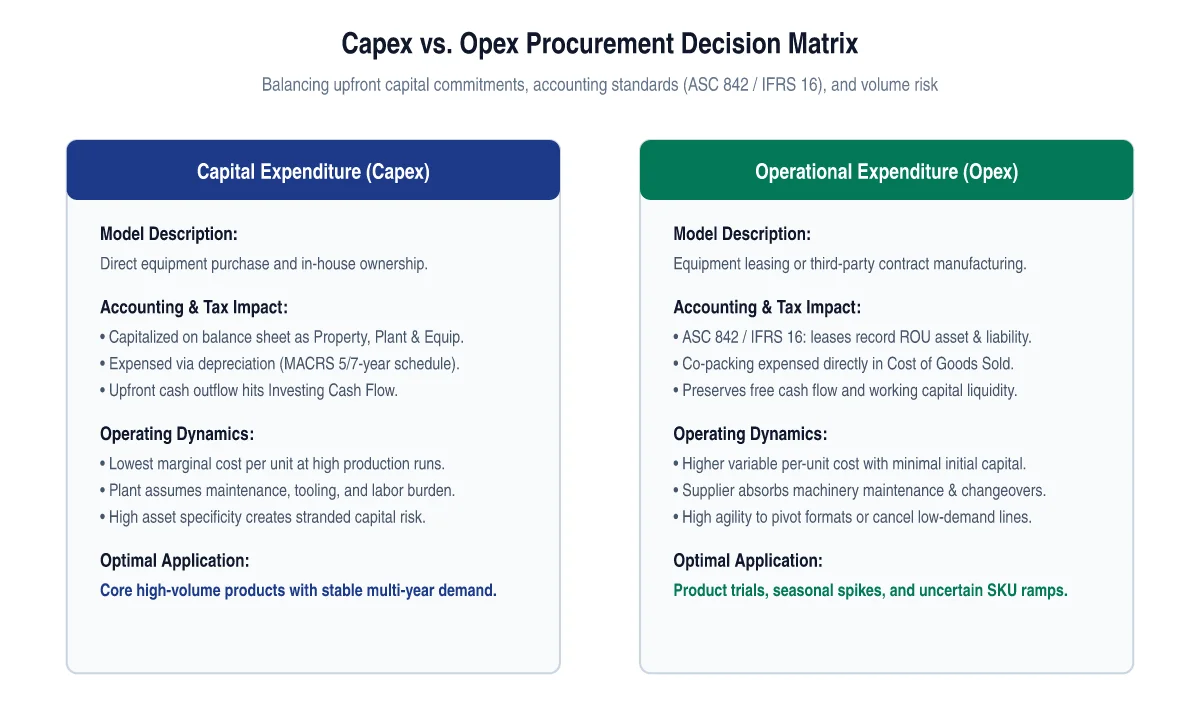
Capex vs Opex in Industrial Manufacturing and Machinery
How do industrial companies evaluate the trade-off between capital expenditure and operational expenditure when acquiring packaging and production capacity?
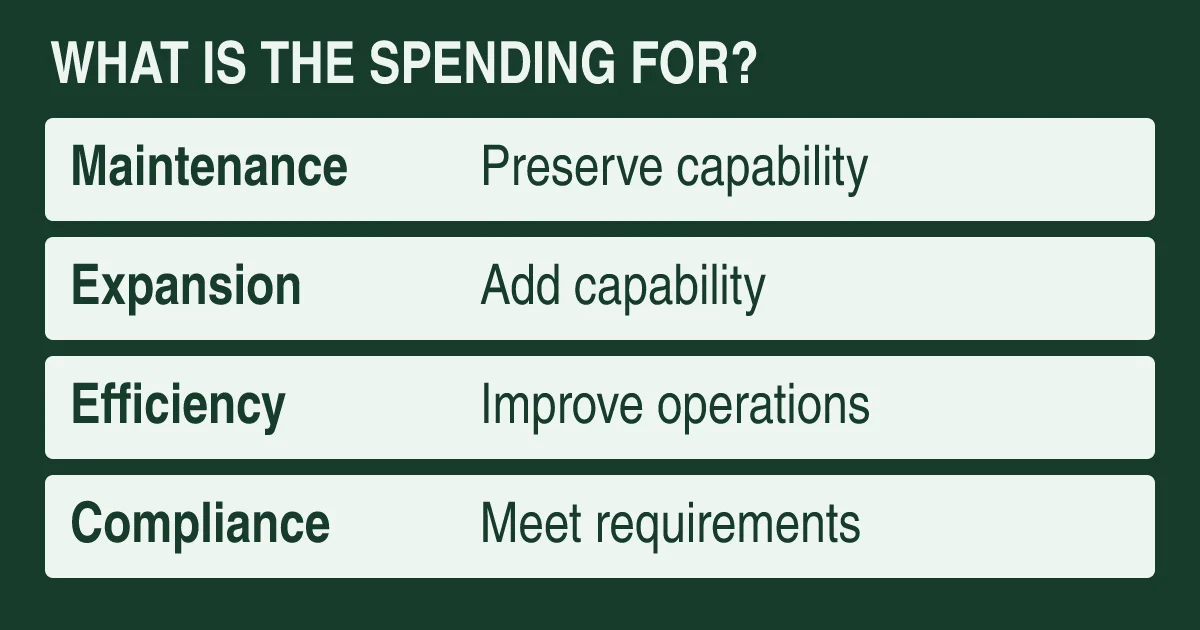
Types of CapEx: Maintenance and Growth
How can a reader identify what capital spending is intended to do without treating a management classification as a standard accounting disclosure?
Oil company profits: drivers, cash flow and capex
What drives oil company profits, and how can researchers trace them into capital spending?
Sources & Data Notes
-
Codifies legal obligation definitions, balance sheet Account 230, depreciation Account 403.1, accretion Account 411.10, subsidiary layer tracking, and settlement gain or loss rules.
-
Oil and gas ARO accounting policy, 2024–2025 rollforward, current versus long-term balance sheet presentation, and non-producing impairment treatment.
-
Mining reclamation rollforward (2024–2025), non-operating Yanacocha estimate adjustments, net reclamation payments, and pledged restricted cash and investments.
-
Three-year mining ARO rollforward (2023–2025) and XBRL codification references to ASC 410-20-45-1, ASC 410-20-45-3, ASC 230-10-45-17, and ASC 410-20-50-1(c)(4).
-
Summary of US GAAP SFAS 143 / ASC 410-20 versus IFRS IAS 37 mechanics and the worked 40-year underground fuel tank numeric example.