
NI 43-101: Mining Disclosure Rules, Studies & QP Role
Key Takeaways
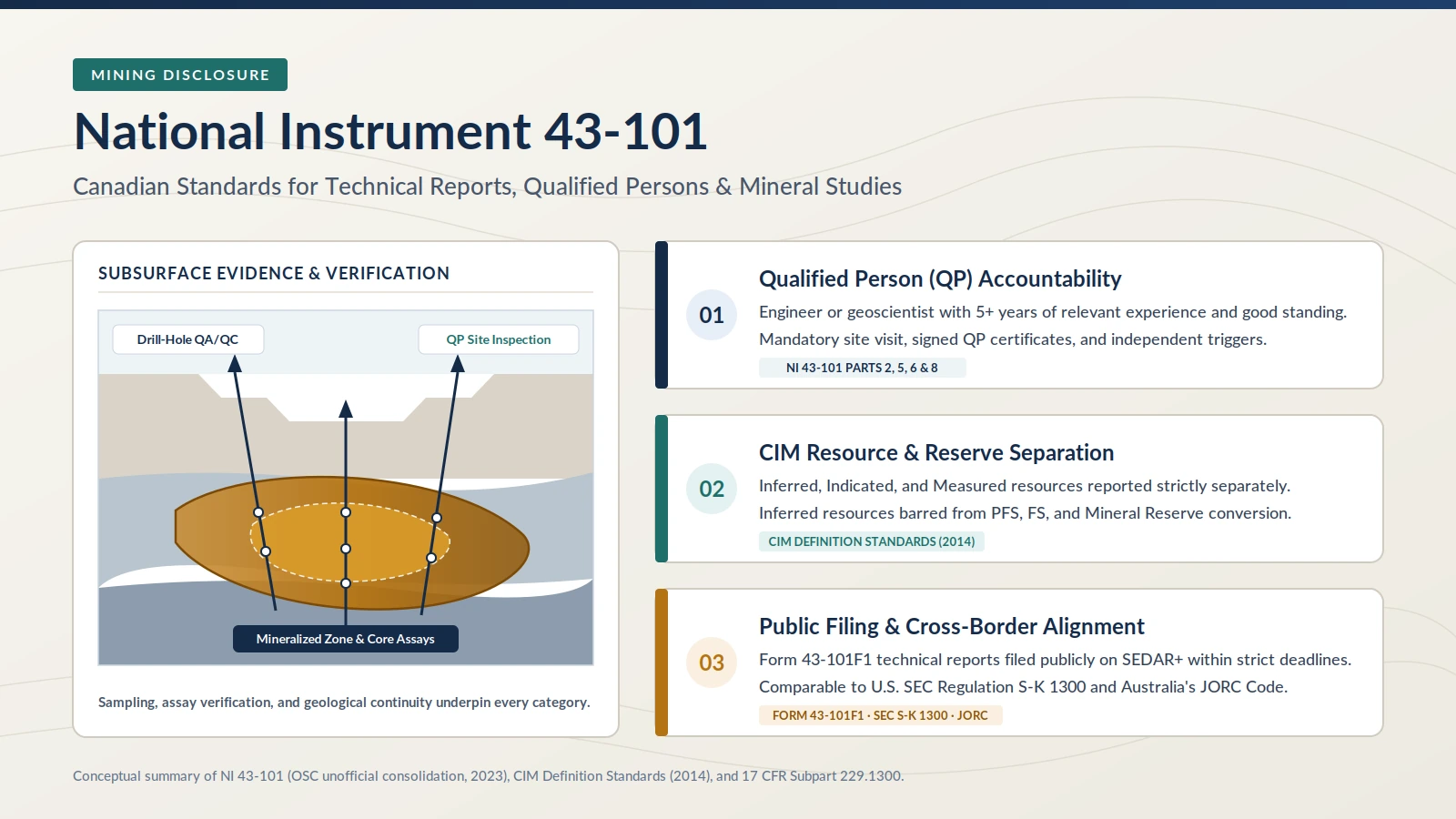
- NI 43-101 governs all public oral, written, and website technical disclosures about material mineral projects in Canada and requires Qualified Person sign-off.
- Mineral Resources and Mineral Reserves must follow CIM Definition Standards strictly by separate category, and Inferred Mineral Resources must never be added to Indicated or Measured categories.
- A Preliminary Economic Assessment (PEA) may include speculative Inferred Resources only with prominent cautionary language, whereas Pre-Feasibility and Feasibility Studies must exclude Inferred Resources entirely.
- The U.S. equivalent is SEC Regulation S-K Subpart 1300, which mandates exclusive resource reporting, permits third-party firm signatures, and codifies quantitative study cost accuracy limits.
Research Scope
- Regions
- Canada (Canadian Securities Administrators via Ontario Securities Commission consolidation) with cross-border comparison to U.S. SEC Regulation S-K 1300 and Australia's JORC Code.
- Period
- NI 43-101 in force June 30, 2011 (unofficial consolidation current to June 9, 2023), CIM Definition Standards adopted May 2014, and SEC S-K 1300 effective for fiscal years beginning on or after January 1, 2021.
- Industries
- Mineral exploration, mine development, precious and base metals, coal, diamonds, industrial minerals, and mining royalty issuers.
- Data objects
- Technical report filing triggers, statutory deadlines, Qualified Person independence thresholds, resource-to-reserve conversion rules, and mining study accuracy tolerances.
National Instrument 43-101 (NI 43-101) is the Canadian securities regulatory framework governing how issuers publicly disclose scientific and technical information about mineral projects. It requires Qualified Person sign-off on material disclosures, enforces separate reporting of CIM Mineral Resource and Mineral Reserve categories, and bars Inferred Resources from Pre-Feasibility and Feasibility Studies.
Within the markets research framework, NI 43-101 functions as a primary screening filter before analyzing mining company financial statements. Checking who verified the geological data, which confidence category holds the tonnage, and which study stage supports the economic model prevents speculative exploration estimates from being misread as bankable mine reserves.
What is an NI 43-101 technical report and when must companies file one?
An NI 43-101 technical report is a public summary document prepared in English or French on Form 43-101F1 containing all material scientific and technical information on a mineral property as of its effective date. Issuers must file it on SEDAR+ upon becoming a Canadian reporting issuer or upon specified financing, corporate, and material-change disclosure triggers.
According to the Ontario Securities Commission unofficial consolidation of National Instrument 43-101 (current to June 9, 2023), the current instrument came into force on June 30, 2011, repealing the December 30, 2005 version. Canadian regulators created NI 43-101 after the Bre-X scandal—in which Busang gold reserves were alleged to reach 200 million ounces (6,200 tonnes), or up to 8% of global gold reserves at the time, before core salting exposed the deposit as fraudulent.
Scope of covered disclosures and mineral projects
NI 43-101 reaches far beyond formal regulatory prospectuses. Section 1.1 defines disclosure as any oral statement or written disclosure made by or on behalf of an issuer that is intended or reasonably likely to become publicly available in Canada, regardless of whether it is formally filed under securities legislation. Written disclosure explicitly encompasses paper and electronic formats, including pictures, maps, and company websites.
The rules apply to any mineral project—spanning exploration, development, production, and royalty or similar interests—involving diamonds, natural solid inorganic material, or natural solid fossilized organic material such as base metals, precious metals, coal, and industrial minerals. Oil, natural gas, and liquid petroleum disclosures fall outside this regime.
Filing triggers and statutory deadlines
Part 4 of NI 43-101 specifies both the events that trigger a technical report on a material property and the exact filing window. Section 4.3 requires every triggered report to be prepared in English or French following Form 43-101F1.
Table 1. NI 43-101 technical report filing triggers and statutory deadlines. Source: Ontario Securities Commission, NI 43-101 Unofficial Consolidation (current to June 9, 2023), Part 4.
Scroll horizontally to view all columns.
| Triggering event | NI 43-101 reference | Filing deadline on SEDAR+ | Accompanying requirement |
|---|---|---|---|
| Becoming a reporting issuer in Canada | Section 4.1 | Upon becoming a reporting issuer | Independent Qualified Person required unless exempt |
| Preliminary prospectus, AIF, M&A proxy circular issuing shares, non-accredited offering memorandum, rights offering, valuation, TSXV short-form offering, or take-over bid offering shares | Section 4.2(1)(a)–(i) | No later than the filing or public release of the triggering document | Must support all material technical claims in the document |
| News release or other written disclosure announcing first-time or materially changed resources, reserves, or PEA | Section 4.2(1)(j) and 4.2(5) | Within 45 days after the disclosure date (or earlier if paired with a preliminary short-form prospectus) | Issue a filing news release reconciling any material differences |
| Directors’ circular containing first-time or materially changed resources, reserves, or PEA | Section 4.2(5)(a)(ii) | Earlier of 45 days after disclosure or 3 business days before expiry of the initial deposit period | Reconcile any material differences upon filing |
| First-time disclosure relying on another issuer’s previously filed technical report for the same property | Section 4.2(7) | Within 180 days after the disclosure date (or earlier if in a preliminary short-form prospectus) | Identify prior report, name reviewing Qualified Person, and confirm no new material adverse data |
What are the NI 43-101 Standards of Disclosure for mineral resources and reserves?
NI 43-101 incorporates the Canadian Institute of Mining, Metallurgy and Petroleum (CIM) Definition Standards by reference, requiring issuers to classify mineralization strictly into Inferred, Indicated, or Measured Mineral Resources and Probable or Proven Mineral Reserves. Issuers must report every category separately and must never add Inferred Mineral Resources to Indicated or Measured categories.
Under the CIM Definition Standards (dated May 10, 2014 and adopted by CIM Council on May 19, 2014), a Mineral Resource is a concentration or occurrence of solid material of economic interest in or on the Earth’s crust with reasonable prospects for eventual economic extraction. CIM guidance illustrates that the meaning of “eventual” depends on the commodity: bulk deposits such as coal, iron, or potash may reasonably span time horizons exceeding 50 years, whereas many gold deposits are normally constrained to 10 to 15 years or shorter.
Resource confidence hierarchy and reserve conversion rules
Geological confidence rises sequentially across the three resource categories, while conversion into a Mineral Reserve requires applying Modifying Factors—mining, processing, metallurgical, infrastructure, economic, marketing, legal, environmental, social, and governmental considerations—through at least a Pre-Feasibility Study. Mineral Reserves explicitly include diluting materials and allowances for mining losses.
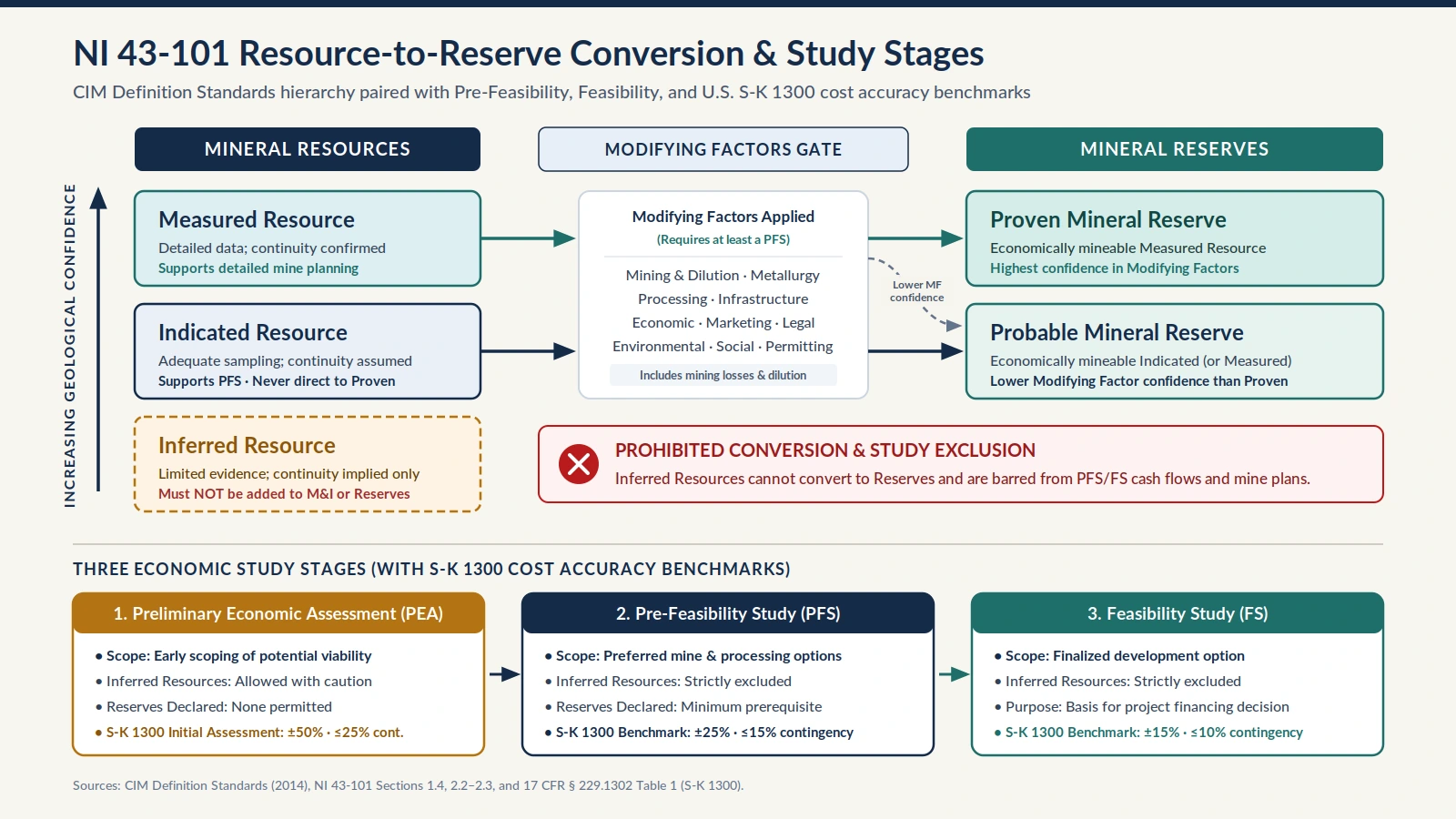
Two conversion boundaries matter most when reviewing a mining issuer’s tables. First, an Inferred Mineral Resource rests on limited geological evidence sufficient only to imply—not verify—continuity; it can never convert directly to a Mineral Reserve and is barred from the economic analyses, production schedules, and estimated mine life of publicly disclosed Pre-Feasibility and Feasibility Studies. Second, an Indicated Mineral Resource may convert only to a Probable Mineral Reserve and can never convert directly to a Proven Mineral Reserve. Only a Measured Mineral Resource may convert to a Proven Mineral Reserve, or to a Probable Mineral Reserve when confidence in Modifying Factors is lower.
Table 2. CIM Mineral Resource and Mineral Reserve classification and conversion boundaries under NI 43-101. Sources: CIM Definition Standards (2014) and NI 43-101 Sections 1.2, 1.3, and 2.2.
Scroll horizontally to view all columns.
| Category | Geological evidence level | Modifying Factors applied? | Permitted reserve conversion | Allowed in PFS / FS economic model? |
|---|---|---|---|---|
| Inferred Mineral Resource | Limited evidence; continuity implied only | No | None (conversion prohibited) | No (strictly excluded) |
| Indicated Mineral Resource | Adequately detailed; continuity assumed | No | Probable Mineral Reserve only | Yes (supports reserve conversion) |
| Measured Mineral Resource | Detailed and reliable; continuity confirmed | No | Proven or Probable Mineral Reserve | Yes (supports reserve conversion) |
| Probable Mineral Reserve | Indicated (or Measured with lower Modifying Factor confidence) | Yes (at least PFS level) | Already a Mineral Reserve | Yes (includes dilution and losses) |
| Proven Mineral Reserve | Measured Resource with highest Modifying Factor confidence | Yes (at least PFS level) | Already a Mineral Reserve | Yes (includes dilution and losses) |
Under Section 2.2 of NI 43-101 and CIM reporting guidance, every issuer reporting both Mineral Resources and Mineral Reserves must state clearly—using a single consistent convention—whether Measured and Indicated Mineral Resources are inclusive of or additional to Mineral Reserves. Inferred Mineral Resources are always additional to Mineral Reserves. Whenever contained metal is disclosed, Section 2.2(d) also requires stating both tonnage or volume and grade or quality for each category separately.
Restricted disclosures, exploration targets, and historical estimates
Section 2.3(1) of NI 43-101 prohibits four disclosure practices that frequently distort early-stage mining commentary:
- Uncategorized tonnage or grade: Disclosing the quantity, grade, or metal content of a deposit that has not been classified into one of the five CIM resource or reserve categories.
- Inferred-resource economic analyses outside a PEA: Reporting economic results that incorporate Inferred Mineral Resources, conceptual exploration targets, or unverified historical estimates, except under the specific PEA exemption.
- Gross in-situ metal value: Stating the gross dollar value of metal in a deposit, sampled interval, or drill intersection—which ignores recovery losses, mining dilution, capital outlay, and operating costs.
- Unbroken metal-equivalent grades: Reporting a combined metal-equivalent grade for a multi-commodity deposit or drill intercept without disclosing the individual grade of every contributing metal or mineral.
Two narrow exceptions exist with strict cautionary conditions. Under Section 2.3(2), an issuer may disclose a conceptual exploration target in writing expressed as ranges of tonnage and grade only if it states with equal prominence that the figures are conceptual, insufficient exploration has occurred to define a mineral resource, and delineation as a resource remains uncertain. Under Section 2.4, an issuer may cite a historical estimate in its original terminology only by disclosing its source, date, assumptions, category differences, newer data, and required verification work alongside an equally prominent statement that a Qualified Person has not verified it and the issuer is not treating it as current.
What are the NI 43-101 Qualified Person (QP) requirements?
Under NI 43-101 Section 1.1, a Qualified Person (QP) must be an engineer or geoscientist holding a relevant university degree or equivalent accreditation, at least five years of relevant mineral exploration, mine development, operation, or assessment experience, experience relevant to the specific property and technical report, and good standing with a recognized professional association.
Section 2.1 requires that every public scientific or technical disclosure on a material mineral property be based on information prepared by or under the supervision of a QP, or approved by a QP. Under Sections 3.1 and 3.2, written technical disclosures must identify the QP by name and relationship to the issuer, state whether a QP verified the underlying sampling, analytical, and test data, describe how verification was carried out, and disclose any limitations or failures to verify.
Independence triggers, personal inspection, and record retention
Section 1.5 defines a QP as independent if no circumstance exists that, in the opinion of a reasonable person aware of all relevant facts, could interfere with the QP’s professional judgment. Under Section 5.3(1), an independent technical report is mandatory when an issuer becomes a Canadian reporting issuer, files a preliminary prospectus or required valuation, discloses mineral resources, mineral reserves, or PEA results for the first time on a material property, or reports a 100% or greater change in total mineral resources or total mineral reserves since its most recent independent technical report.
An explicit statutory exemption applies to established miners. Under Section 1.1 and Sections 5.3(2)–(3), a producing issuer—defined by audited financial statements showing gross mining revenue of at least CAD 30 million in its most recent financial year and at least CAD 90 million in aggregate across its three most recent financial years—is exempt from the independent QP requirement for standard filings (and upon becoming a reporting issuer if its shares trade on a specified exchange).
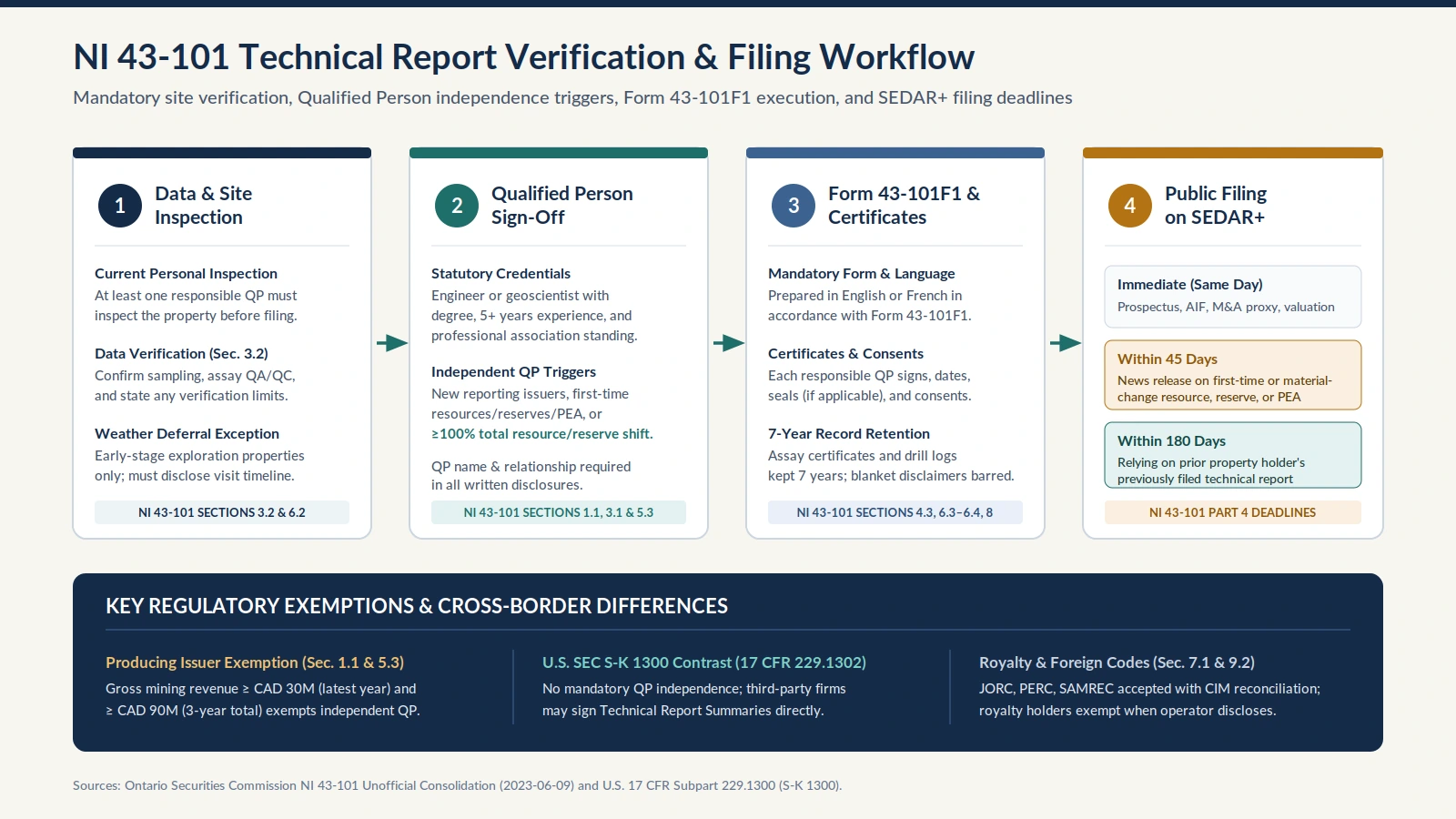
NI 43-101 reinforces QP accountability with four operational safeguards:
- Current personal inspection (Section 6.2): Before filing a technical report, at least one responsible QP must physically inspect the subject property. Deferral is permitted only for an early-stage exploration property blocked by seasonal weather conditions, and the issuer must disclose the reason and planned inspection timeframe.
- Signed and sealed QP certificates (Section 8.1): Every responsible QP must file a dated, signed, and (where applicable) sealed certificate confirming their qualifications, responsible sections, inspection date, and compliance.
- Seven-year record retention (Section 6.3): Issuers must preserve copies of assay and analytical certificates, drill logs, and supporting technical report records for 7 years.
- Restriction on disclaimers (Section 6.4): Technical reports cannot include QP disclaimers limiting reliance on sections the QP prepared or restricting public reproduction on SEDAR+, except for narrowly bounded reliance disclosures permitted under Item 3 of Form 43-101F1.
How does an NI 43-101 feasibility study differ from a pre-feasibility study and a PEA?
A Preliminary Economic Assessment (PEA) is a preliminary scoping study that may incorporate speculative Inferred Mineral Resources with prominent cautionary language, whereas a Pre-Feasibility Study (PFS) is the minimum engineering threshold required to convert Measured and Indicated Resources into Mineral Reserves, and a Feasibility Study (FS) delivers the detailed technical and financial confidence needed for a final development or project-financing decision.
The most common analytical mistake in junior mining research is treating a headline net present value from a PEA as though it carried the same certainty as a Feasibility Study. Under Section 2.3(3) of NI 43-101, any PEA that includes Inferred Mineral Resources must state with equal prominence that the study is preliminary in nature, incorporates Inferred Resources considered too speculative geologically for reserve classification, has no certainty of realization, and must describe how the PEA affects any existing PFS or FS on the property.
Section 2.3(4) further forbids issuers from labeling a report as a preliminary feasibility study, pre-feasibility study, or feasibility study unless it satisfies CIM Section 1.4 criteria. Under Section 3.4(e), any written disclosure presenting an economic analysis of Mineral Resources must state with equal prominence that mineral resources that are not mineral reserves do not have demonstrated economic viability.
Comparing engineering confidence and cost accuracy across study stages
While CIM and NI 43-101 define study progression qualitatively—from conceptual options in a PEA, to preferred mining method and processing selection in a PFS, to finalized project execution design in an FS—the U.S. SEC Regulation S-K Subpart 1300 codifies explicit quantitative cost-estimation tolerances in Table 1 to § 229.1302(d). Pairing CIM definitions with those codified U.S. engineering thresholds clarifies how sharply uncertainty narrows across stages.
Table 3. Structural boundaries across PEA / Initial Assessment, Pre-Feasibility Study, and Feasibility Study stages. Sources: CIM Definition Standards (2014), NI 43-101 Sections 1.1, 1.4, and 2.3, and Regulation S-K § 229.1302 Table 1 (S-K 1300).
Scroll horizontally to view all columns.
| Dimension | PEA (NI 43-101) / Initial Assessment (S-K 1300) | Pre-Feasibility Study (PFS) | Feasibility Study (FS) |
|---|---|---|---|
| Primary purpose | Scoping analysis of potential resource viability | Compare options; establish preferred mining method or pit design and processing route | Detailed study of selected option to support final development or financing decision |
| Mineral Reserves permitted? | No | Yes (minimum prerequisite for reserves) | Yes (highest reserve confidence) |
| Inferred Resources in cash flow? | Allowed only with prominent cautionary language (plus non-inferred case under S-K 1300) | Strictly prohibited | Strictly prohibited |
| S-K 1300 capital & operating cost accuracy | At least ±50% (if cash flow included) | At least ±25% | At least ±15% |
| S-K 1300 maximum contingency allowance | ≤25% (if cash flow included) | ≤15% | ≤10% |
What technical sections and disclosures belong in a mining technical report?
An NI 43-101 technical report must follow the standardized Form 43-101F1 architecture, progressing sequentially from property description, geology, drilling, QA/QC, and QP data verification through resource and reserve estimation, engineering methods, economic analysis, conclusions, and signed QP certificates. Its modular layout closely mirrors the 25-section Technical Report Summary codified under U.S. Regulation S-K § 229.601(b)(96).
In both Canadian Form 43-101F1 filings and the parallel Regulation S-K § 229.601(b)(96) Technical Report Summary, technical evidence follows an auditable chain of custody. Early sections document property title, access, geological setting, exploration, sample preparation, analytical security, and QP data verification. Mid-report sections establish Mineral Resource estimates, Mineral Reserve conversions, mining and recovery methods, infrastructure, market studies, and environmental or permitting plans. Closing sections present capital and operating cost breakdowns, life-of-mine economic analysis—including annual cash flow schedules, net present value (NPV), internal rate of return (IRR), capital payback period, and sensitivity analyses—followed by risks, recommendations, references, and Item 3 reliance disclosures.
Technical report verification checklist for analysts
Before citing tonnage, grade, or projected cash flows from a mining filing, apply a consistent source check alongside the standards in our editorial policy and data and sources directory.
Table 4. NI 43-101 technical report reader verification checklist. Synthesis of NI 43-101 Parts 2–8 and CIM Definition Standards (2014).
Scroll horizontally to view all columns.
| Verification item | What to check inside the filing | Risk or failure mode prevented |
|---|---|---|
| Effective date & filing vintage | Confirm report effective date and whether a newer 45-day reconciling release exists | Relying on superseded drilling or stale price assumptions |
| Qualified Person status | Verify QP name, professional association, independence (Section 5.3), and inspection date | Overlooking non-independent sign-off or deferred site visits |
| Data verification & Item 3 | Read QP verification procedures, analytical limitations, and Item 3 reliance carve-outs | Missing unverified assays or third-party legal/permitting caveats |
| Resource vs reserve basis | Confirm whether Measured and Indicated Resources are inclusive of or additional to Reserves | Double-counting tonnage by adding inclusive resources to reserves |
| Inferred Resource boundary | Verify Inferred tonnage is never added to M&I totals and excluded from PFS/FS cash flows | Mistaking speculative PEA models for reserve-backed feasibility cash flows |
| Commodity & Modifying Factors | Inspect cut-off grades, reference point (mill feed vs saleable product), dilution, and recovery | Comparing incompatible resource grades across peer deposits |
When bridging project-level technical reports to corporate capital allocation and balance-sheet capacity, compare the study’s capital schedule against issuer-level spending disclosures using a structured cash-flow lens such as our guide to oil company profits and capex.
What is the U.S. equivalent of NI 43-101, and how does it compare with S-K 1300 and JORC?
The U.S. equivalent of NI 43-101 is SEC Regulation S-K Subpart 1300 (§§ 229.1300–229.1305), which replaced Industry Guide 7 and became mandatory for fiscal years beginning on or after January 1, 2021. While NI 43-101, S-K 1300, and Australia’s JORC Code share CRIRSCO resource-and-reserve foundations, they differ materially on public report filing, exclusive resource tables, QP independence, and firm signatures.
As announced in the SEC Press Release 2018-248 (October 31, 2018) and codified at 83 FR 66448 (December 26, 2018), S-K 1300 modernized U.S. mining rules by permitting Mineral Resource disclosures alongside reserves and requiring a signed Technical Report Summary exhibit on EDGAR for material properties. However, cross-border analysts cannot treat NI 43-101 and S-K 1300 tables as interchangeable without checking four structural differences:
- Exclusive resource reporting: NI 43-101 allows issuers to present Measured and Indicated Resources either inclusive of or additional to Mineral Reserves with a clear statement, whereas SEC S-K 1300 mandates that all registrant mineral resource disclosures be exclusive of mineral reserves.
- Dual Inferred-Resource economic display: When an S-K 1300 Initial Assessment includes Inferred Resources in its cash flow model, § 229.1302(d)(4)(ii) requires disclosing the exact percentage classified as inferred and presenting with equal prominence the economic results excluding inferred resources.
- Firm signatures and QP independence: NI 43-101 mandates individual QP certificates and triggers independent QPs for IPOs, first-time disclosures, and 100%+ resource/reserve shifts (outside producing issuers). S-K 1300 does not require QP independence—requiring affiliation disclosure instead—and allows a third-party engineering firm to sign a Technical Report Summary without naming its individual employee QP.
- JORC Code public-filing boundary: Under Section 7.1 of NI 43-101, foreign issuers (or Canadian issuers reporting foreign properties) may use acceptable foreign codes—including JORC, PERC, SAMREC, SEC Industry Guide 7, and Chile’s Certification Code—with a reconciliation to CIM categories. However, because JORC is set by an industry committee rather than a securities regulator, full technical reports are not routinely published on the Australian Stock Exchange.
Table 5. Regulatory comparison of NI 43-101 (Canada), SEC Regulation S-K 1300 (United States), and JORC Code (Australia). Sources: OSC NI 43-101 Consolidation (2023), Regulation S-K Subpart 229.1300, and SEC Press Release 2018-248.
Scroll horizontally to view all columns.
| Regulatory dimension | NI 43-101 (Canada) | SEC S-K 1300 (United States) | JORC Code (Australia) |
|---|---|---|---|
| Governing authority | Canadian securities regulators (securities law) | U.S. Securities and Exchange Commission (Regulation S-K Subpart 229.1300) | Joint Ore Reserves Committee (industry professional body) |
| Full technical report filed publicly? | Yes — Form 43-101F1 on SEDAR+ | Yes — Technical Report Summary exhibit on EDGAR | Not commonly published in full on the ASX |
| Resource reporting vs reserves | Inclusive or additional permitted with clear clarifying statement | Strictly exclusive of Mineral Reserves in registrant filings | Both permitted with clear statement |
| Early study with Inferred Resources | PEA allowed with prominent cautionary text & prior-study impact | Initial Assessment allowed only with % inferred and equally prominent results excluding inferred | Scoping study subject to exchange cautionary rules |
| Quantitative cost accuracy limits | Qualitative CIM progression (no statutory percentage table) | Codified: ±50% (IA), ±25% (PFS), ±15% (FS) | Guided by industry practice rather than statutory table |
| QP / CP signature & independence | Individual QP certificates; mandatory independence triggers (exempts CAD 30M/90M producers) | Third-party firm may sign without naming employee; affiliation disclosed (no independence mandate) | Individual Competent Person (5+ years deposit-type experience) |
Frequently asked questions
What does NI 43-101 stand for?
NI 43-101 stands for National Instrument 43-101, Standards of Disclosure for Mineral Projects. It is a Canadian securities regulatory instrument (current version in force since June 30, 2011) that governs how issuers publicly disclose scientific and technical information, mineral resources, mineral reserves, and economic studies for mineral projects.
Can an NI 43-101 technical report include Inferred Mineral Resources in a Feasibility Study?
No. Under CIM Definition Standards incorporated into NI 43-101, Inferred Mineral Resources must not be converted into Mineral Reserves and must not be included in the economic analysis, production schedules, or estimated mine life of a Pre-Feasibility Study or Feasibility Study. Inferred Resources may appear in a Preliminary Economic Assessment (PEA) only with equally prominent cautionary disclosure.
How long does a mining company have to file an NI 43-101 technical report after a news release?
Under Section 4.2(5) of NI 43-101, an issuer that triggers a technical report through a news release disclosing first-time or materially changed mineral resources, mineral reserves, or PEA results must file the report on SEDAR+ within 45 days (accompanied by a news release reconciling any material differences). That window extends to 180 days under Section 4.2(7) when relying on another issuer’s previously filed technical report with QP review disclosure.
When must an NI 43-101 Qualified Person be independent of the mining company?
Under Section 5.3(1), all responsible Qualified Persons must be independent when an issuer becomes a Canadian reporting issuer, files a preliminary prospectus or required valuation, discloses first-time resources, reserves, or PEA results on a material property, or reports a 100% or greater change in total resources or reserves since its last independent technical report. Producing issuers with at least CAD 30 million in latest-year gross mining revenue and CAD 90 million over three years are generally exempt.
What is the main difference between NI 43-101 and U.S. SEC S-K 1300?
Both align with CRIRSCO definitions, but SEC Regulation S-K Subpart 1300 (mandatory for fiscal years beginning on or after January 1, 2021) requires registrant mineral resource tables to be reported strictly exclusive of mineral reserves, codifies quantitative study cost accuracy ceilings (±50%, ±25%, and ±15%), requires Initial Assessments using Inferred Resources to show equally prominent economic results excluding Inferred Resources, and permits third-party firms to sign Technical Report Summaries without mandatory QP independence.
Continue the research
Related Research

Oil company profits: drivers, cash flow and capex
What drives oil company profits, and how can researchers trace them into capital spending?

EIA Natural Gas Data vs the API Weekly Statistical Bulletin: Storage Report Scope and Revision Rules
Which energy dataset answers a natural-gas research question, and how should its coverage and revisions be recorded?

3-2-1 Crack Spread: Formula, Refinery Margin & Limits
What is the 3-2-1 crack spread, how is it calculated, and why does it differ from actual refinery profit?
Sources & Data Notes
- National Instrument 43-101 Standards of Disclosure for Mineral Projects (Unofficial consolidation)
Definitions, Qualified Person requirements, restricted disclosures, filing triggers, 45-day and 180-day deadlines, independence rules, 7-year record retention, and foreign code recognition.
- CIM Definition Standards for Mineral Resources & Mineral Reserves
Incorporated definitions of Mineral Resource, Inferred, Indicated, Measured, Modifying Factors, Mineral Reserve, Probable, Proven, Pre-Feasibility Study, and Feasibility Study.
-
U.S. Regulation S-K 1300 definitions, study cost accuracy and contingency ceilings, dual economic disclosure for Inferred Resources, exclusive resource reporting, and third-party firm signatures.
-
Codified 25-section technical report summary structure, including economic analysis metrics (annual cash flows, NPV, IRR, payback, sensitivity).
-
Rescission of Industry Guide 7, CRIRSCO alignment, and two-year transition to fiscal years beginning on or after January 1, 2021.
-
Bre-X Busang historical context (alleged 200 million ounces / 6,200 t gold) and regulatory comparison with Australia's JORC Code.