
Unlevered Free Cash Flow: Formula, DCF Use & Levered Split
Key Takeaways
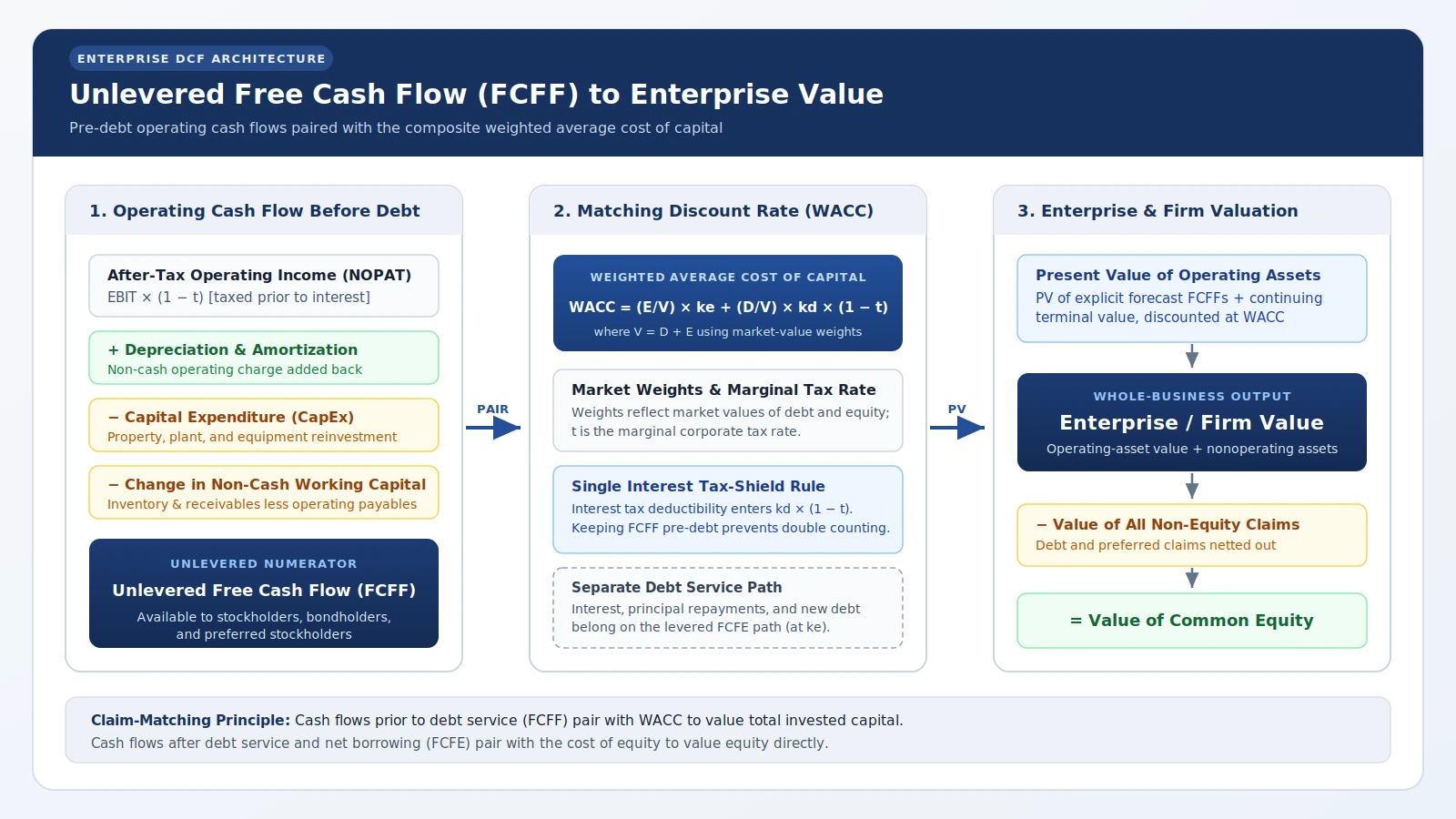
- Unlevered free cash flow, or free cash flow to the firm, equals EBIT times (1 minus the tax rate), plus depreciation, minus capital expenditure, minus the change in working capital.
- Bridging from unlevered FCFF to levered free cash flow to equity subtracts after-tax interest expense and principal repaid, adds new debt issued, and subtracts preferred dividends.
- Enterprise valuation discounts unlevered cash flows at the weighted average cost of capital so the interest tax benefit is counted once in the after-tax cost of debt.
Research Scope
- Regions
- United States GAAP and SEC financial-statement classifications alongside corporate-finance valuation identities.
- Period
- Annual financial-statement cash-flow identities and multi-period discounted cash flow valuation models.
- Industries
- Capital-intensive industrial and resource businesses where capital expenditure and working-capital changes separate earnings from cash flow.
- Data objects
- EBIT, NOPAT, EBITDA, net income, depreciation, capital expenditure, change in working capital, FCFF, FCFE, WACC, and cost of equity.
Unlevered free cash flow, also called free cash flow to the firm (FCFF), is the sum of the cash flows to all claim holders in the business—stockholders, bondholders, and preferred stockholders—estimated prior to debt payments and after taxes and reinvestment needs. Intrinio uses the same two names, UFCF and FCFF, to describe cash generated from operations that is available to both debt and equity holders, and Kimberly Advisors defines unlevered free cash flows as cash available to all debt and equity providers after operating expenses, working capital funding, and capital expenditures. From operating profit on the income statement, FCFF equals EBIT times (1 minus the tax rate), plus depreciation, minus capital expenditure, minus the change in working capital; from EBITDA, Wikipedia’s generally accepted unlevered definition is EBITDA minus capital expenditure, minus changes in net working capital, minus taxes.
In enterprise discounted cash flow analysis, unlevered free cash flow is discounted at the composite cost of capital—the weighted average cost of capital (WACC)—to yield the value of the operating assets of the firm. Nonoperating assets are added to operating-asset value to arrive at firm value, and netting out the value of all non-equity claims converts firm value into equity value. Within our broader valuation research section, keeping pre-debt operating cash flows separate from debt service prevents mixing capital-structure choices into operating performance.
How do you calculate unlevered free cash flow from financial statements?
Calculating unlevered free cash flow starts from operating earnings prior to debt and preferred claims rather than from a bottom-line residual after interest. In Damodaran’s firm-valuation chapter, FCFF equals EBIT times (1 minus the tax rate), plus depreciation, minus capital expenditure, minus the change in working capital. Damodaran’s cash-flow note expresses the same quantity as after-tax operating income minus reinvestment, where reinvestment equals capital expenditures minus depreciation plus the change in non-cash working capital. Dirk Jenter’s MIT 15.402 Lecture 12 writes the equivalent identity as (1 minus t) times EBIT, plus depreciation, minus CAPX, minus the change in NWC, and Wikipedia’s investment-banking formula writes after-tax operating income plus noncash charges such as D&A, minus CAPEX, minus working capital expenditures.
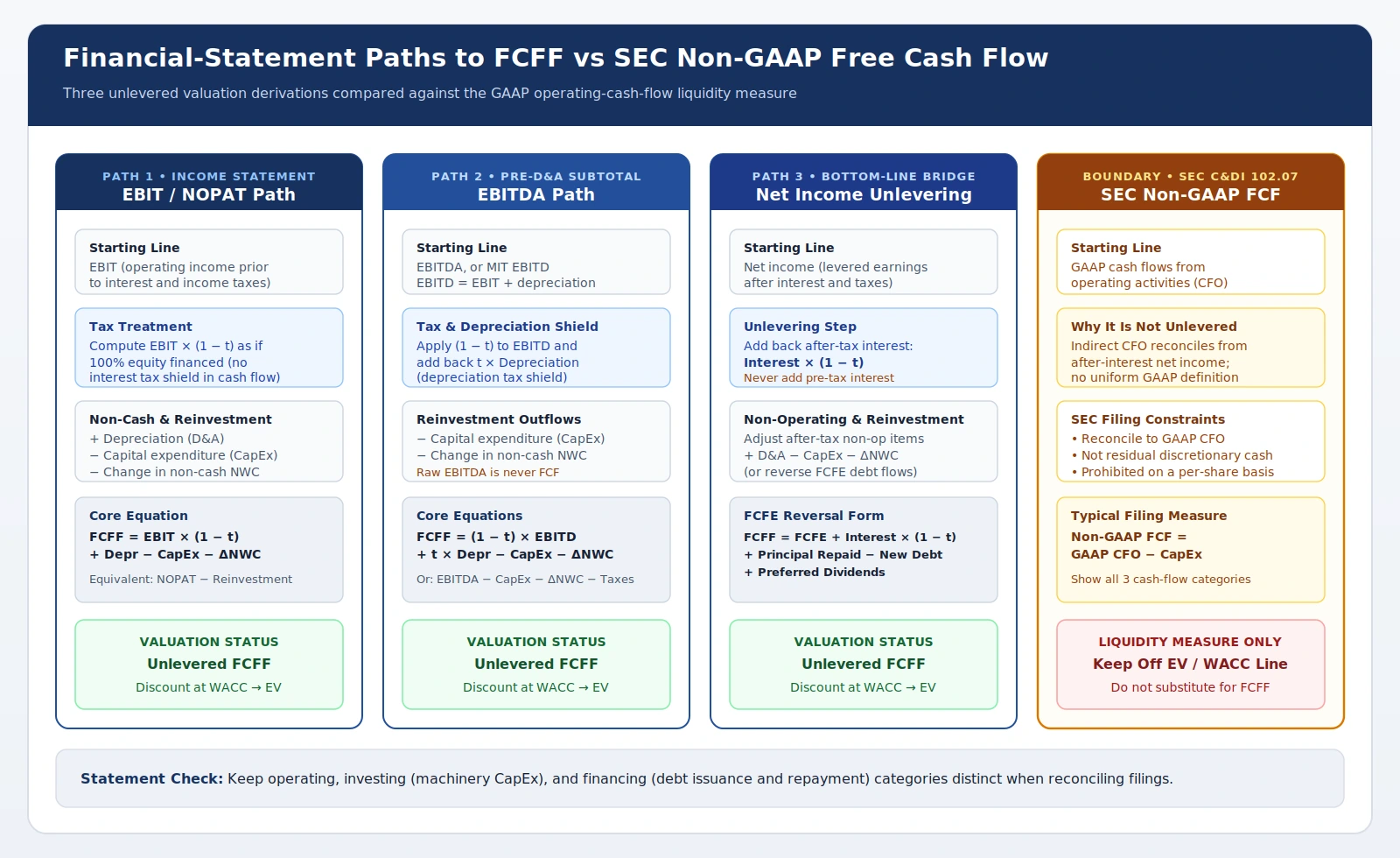
Reading the financial statements directly requires keeping operating, investing, and financing sections distinct rather than collapsing them into one shortcut. As the SEC Beginners’ Guide to Financial Statements and the SEC cash-flow statement building-blocks sheet explain, cash flow statements divide money exchanges into operating activities, investing activities (such as buying machinery or property, plant, and equipment), and financing activities (such as selling stocks and bonds, borrowing from banks, or paying back a bank loan). Under the indirect method, the operating section starts with net income—which is already after interest expense and income taxes—and reconciles to operating cash flow by adding back non-cash items such as depreciation and adjusting for changes in current operating assets and liabilities.
In SEC Non-GAAP Compliance and Disclosure Interpretations Question 102.07 (referenced in the SEC Financial Reporting Manual), companies that report non-GAAP free cash flow typically calculate it as GAAP cash flows from operating activities less capital expenditures. Although Item 10(e)(1)(ii) of Regulation S-K does not prohibit deducting capital expenditures from GAAP operating cash flows, the SEC staff warns that this measure lacks a uniform definition, requires a clear calculation description and reconciliation, should presentation-wise be accompanied by the three major cash-flow statement categories under Question 102.06, should not imply residual cash available for discretionary spending when mandatory debt service exists, and must not be presented on a per-share basis under Question 102.05 (citing Accounting Series Release No. 142 and Accounting Standards Codification 230). Because GAAP operating cash flow starts from after-interest net income, that SEC liquidity measure is not unlevered FCFF; moving from an equity cash flow to FCFF adds back after-tax interest expense—written by Kimberly Advisors on the net-income path as interest expense times (1 minus tax)—alongside debt principal and preferred adjustments where equity cash flows are reversed.
Statement-level cash flows also carry three practical limits in industrial and resource research. Cash flows are related to, but not equivalent to, net income: even profitable businesses may have negative free cash flows, such as a rapidly growing manufacturer with a positive cash conversion cycle whose cash gets stuck in inventory and accounts receivable. Expenditures for capital assets that last decades may be infrequent and costly, making free cash flow vary from year to year so no particular year is a repeatable norm, and the split between maintenance capex and growth capex is neither a GAAP requirement nor audited, leaving maintenance capex open to estimation or management discretion.
What is the unlevered free cash flow formula from EBIT or EBITDA?
Kimberly Advisors notes that unlevered free cash flows can be calculated from three starting lines: EBIT, EBITDA, or net income. Starting from EBIT (earnings before interest and taxes), both Damodaran and MIT 15.402 compute FCFF as EBIT times (1 minus t), plus depreciation, minus capital expenditure, minus the change in working capital, where the change in NWC is also called investment in NWC. When reinvestment is expressed as a share of after-tax operating profit, Damodaran’s note also writes FCFF as EBIT times (1 minus t) times (1 minus the reinvestment rate).
Starting from EBITDA (or EBITD, defined in MIT 15.402 as EBIT plus depreciation), MIT Lecture 12 gives an algebraically equivalent expression: (1 minus t) times EBITD, plus t times depreciation, minus CAPX, minus the change in NWC. Multiplying EBITD by (1 minus t) taxes the depreciation portion as if it were cash profit, so adding t times depreciation restores the depreciation tax shield. Wikipedia states the unlevered definition in compact form as EBITDA minus CAPEX minus changes in net working capital minus taxes, calling that formula the generally accepted definition of unlevered free cash flow.
On Dirk Jenter’s MIT 15.402 Spring 2003 Lecture 12 classroom slide (not a company filing), those unlevered EBIT mechanics appear as the numerical course line FCF = 315 * (1-.38) + 35 - 40 - 15 = 175.3, where taxes are computed directly on EBIT of 315 at a .38 rate, depreciation of 35 is added back, CAPX of 40 and the NWC change of 15 are subtracted, and interest payments are ignored at the cash-flow stage.
Scroll horizontally to view all columns.
| Starting line or subtotal | Algebraic relationship to FCFF | Analytical boundary |
|---|---|---|
| EBIT (operating income) | EBIT × (1 − t) + Depreciation − Capital expenditure − Change in working capital | Taxes are computed on EBIT prior to interest; financing effects stay out of cash flows |
| EBITDA / EBITD | (1 − t) × EBITD + t × Depreciation − CAPX − Change in NWC, or EBITDA − CAPEX − Change in NWC − Taxes | Raw EBITDA omits taxes, capital expenditures, and working-capital requirements |
| After-tax operating income (NOPAT) | After-tax operating income − (Capital expenditures − Depreciation + Change in non-cash working capital) | Discounting after-tax operating income alone assumes zero net reinvestment and zero growth |
| Raw EBITDA discounted directly | Not a valid free cash flow measure | Discounting EBITDA at cost of capital assumes zero taxes and active disinvestment, which conflicts with growth or infinite life |
Treating EBITDA or operating profit itself as free cash flow introduces severe valuation errors. Damodaran emphasizes that while EBITDA is widely used, FCFF accounts for the tax liability on earnings as well as capital expenditures and working-capital requirements: discounting raw EBITDA at the cost of capital assumes there are no taxes and that the firm actively disinvests over time, making a growth rate or infinite life inconsistent. Discounting after-tax operating income directly at the cost of capital assumes zero net reinvestment—depreciation is reinvested only to maintain existing assets—which permits an infinite life assumption without growth.
Unlevered vs levered free cash flow: what changes?
Unlevered free cash flow is measured before interest payments and ignores capital structure, whereas levered free cash flow—also called free cash flow to equity (FCFE)—is the cash left over for shareholders after debt service, preferred dividends, and reinvestment needs, discounted at the cost of equity. As Damodaran summarizes, firm cash flows are based on operating income prior to debt payments, while equity cash flows are based on net income after interest expenses and taxes. Where mandatory debt repayments exist, Wikipedia notes that analysts using levered free cash flow take the unlevered formula less interest and mandatory principal repayments.
In corporate-finance and investment-banking notation, the bridge between the two streams isolates financing cash flows. Wikipedia writes the direct equity formula as Net income + Noncash charges (such as D&A) − CAPEX − Change in non-cash working capital + Net borrowing, and writes the direct link to FCFF as FCFE = FCFF + Net borrowing − Interest × (1 − t). Including preferred stock and separating debt inflows from repayments, Damodaran’s firm-valuation summary table bridges from FCFF to equity cash flow by subtracting Interest × (1 − t), subtracting principal repaid, adding new debt issued, and subtracting preferred dividends; reversing that bridge recovers FCFF as FCFE + Interest expense × (1 − Tax rate) + Principal repayments − New debt issues + Preferred dividends.
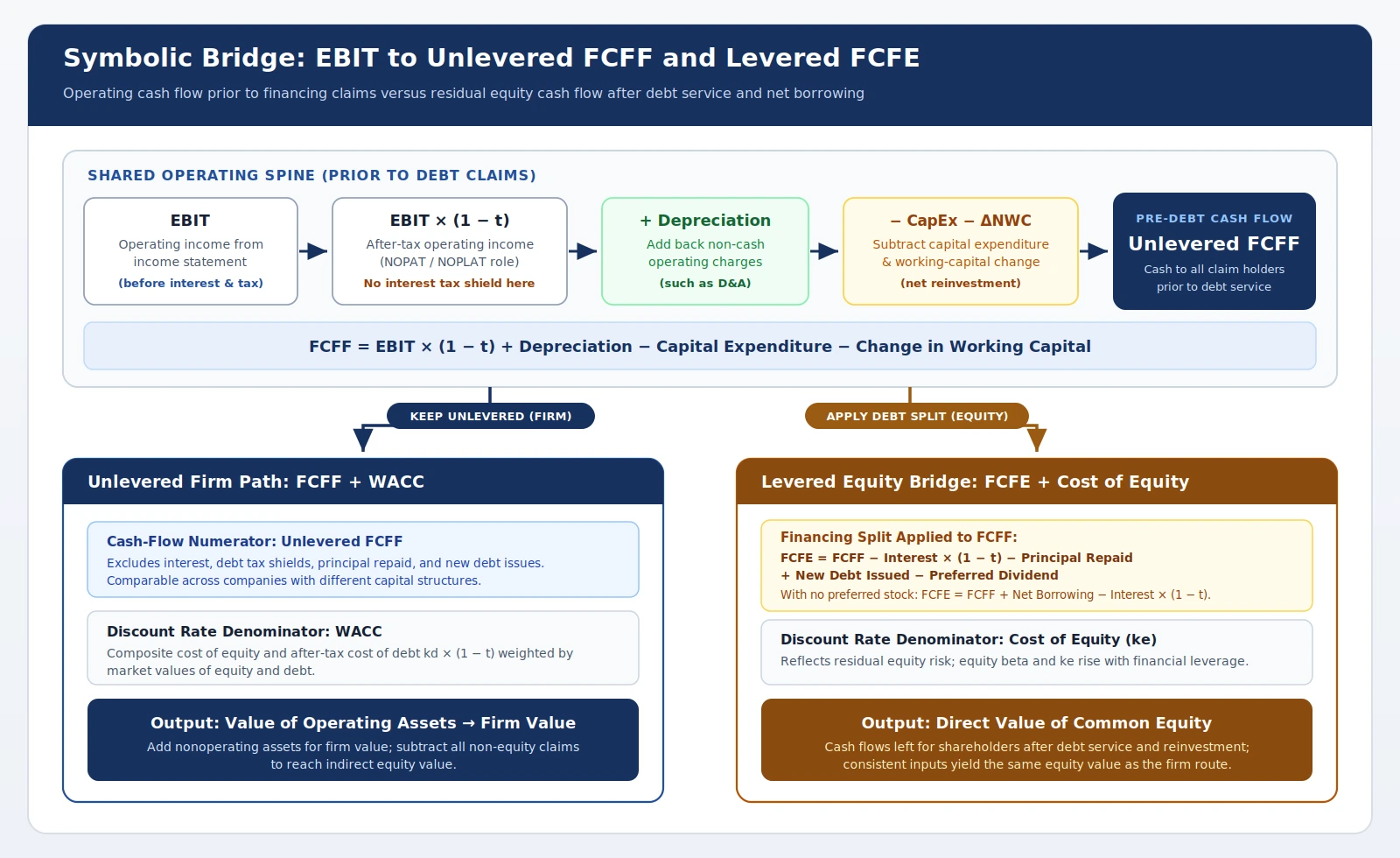
Because debt cash flows sit between FCFF and FCFE, the two measures can carry opposite signs in the same reporting period. Even highly levered firms that are actively paying down debt will report positive FCFF while registering negative FCFE, because debt repayments reduce the equity residual without making operating firm cash flow negative.
Scroll horizontally to view all columns.
| Comparison dimension | Unlevered free cash flow (FCFF / UFCF) | Levered free cash flow (FCFE) |
|---|---|---|
| Claim holders served | All claim holders: stockholders, bondholders, and preferred stockholders | Common equity holders after non-equity claims are met |
| Earnings starting point | Operating income (EBIT) or after-tax operating income prior to interest | Net income after interest expenses and taxes |
| Debt interest and principal | Excluded from cash flows; prior to interest, principal repayments, and new debt | Subtracts after-tax interest and principal repaid; adds new debt issued (net borrowing) |
| Matching discount rate | Weighted average cost of capital (WACC) | Cost of equity (ke or re) |
| Immediate present-value output | Value of operating assets (add nonoperating assets for firm value) | Direct value of equity in the business |
Why does enterprise DCF use unlevered free cash flow?
In discounted cash flow analysis, valuation incorporates the time value of money by discounting estimated future cash flows at a cost of capital that reflects their risk and timing, and Damodaran’s introduction to valuation identifies two primary DCF routes: firm (or enterprise) valuation and direct equity valuation. Enterprise DCF values the entire business—both assets in place and growth assets—by discounting unlevered free cash flows to the firm plus a continuing value beyond the explicit forecast horizon at WACC; Kimberly Advisors similarly notes that DCF valuation aims to show the enterprise value of a business independent of its capital structure. By contrast, the flows-to-equity route discounts cash flows available to equity holders after debt servicing costs at the cost of equity.
Unlevered cash flow is usually used as the norm across peers because excluding interest and principal payments allows easier comparison of operating cash generation across companies with different leverage, and it is preferred when testing the impact of different capital structures on the business (where the optimal financing mix is the one that maximizes firm value, or where the adjusted present value approach adds the marginal impact of debt to unlevered firm value). Done consistently, indirect firm valuation—valuing the firm and netting out all non-equity claims—and direct equity valuation give the same equity value. Both the income stream selected and the associated cost-of-capital model determine the result: for a side-by-side comparison of dividend discount, FCFE, FCFF, and earnings-multiple equations, see our stock valuation formulas guide, and for how market capitalization differs from enterprise and intrinsic estimates, see market cap versus valuation.
Regardless of whether the analyst chooses the unlevered firm route or the levered equity route, terminal value often represents a large share of total DCF value and is highly sensitive to growth and discount-rate assumptions, meaning small input shifts can produce large changes in estimated company value.
How does NOPAT feed into unlevered free cash flow?
In corporate finance, net operating profit after tax (NOPAT) is a company’s after-tax operating profit for all investors, including shareholders and debt holders, and serves as the unlevered earnings base before reinvestment in the FCFF identity. On an income statement, deducting operating expenses from gross profit yields operating profit before interest and income tax expenses—often called income from operations or EBIT—whereas interest income and interest expense are applied afterward to reach profit before income tax, from which income tax is deducted to arrive at net income. Adjustments to EBIT produce net operating profit or loss after taxes (NOPLAT), while Damodaran defines net operating income (NOI) as income from operations prior to taxes and nonoperating expenses.
When working from bottom-line net income under Wikipedia’s financing perspective, calculating NOPAT removes interest expense and non-operating activities—excluding one-time losses and other non-recurring charges that do not represent ongoing profitability—by adding after-tax interest expense back to net income and adjusting for after-tax non-operating gains and losses. Subtracting net investment needs (capital expenditures minus depreciation plus the change in non-cash working capital) from after-tax operating income then produces FCFF.
A critical tax rule governs that NOPAT step: taxes on operating income are computed as if the firm were taxed on its entire operating income with no interest expenses and no interest tax benefits. Damodaran’s chapter and cash-flow footnote stress that omitting the interest tax shield from FCFF is intentional because the after-tax cost of debt inside WACC already counts that tax benefit; using actual taxes paid (which are reduced by interest deductions) or reflecting interest tax benefits in the cash flows counts the tax shield twice.
Why is unlevered free cash flow discounted with WACC?
Matching the cash-flow numerator to the discount-rate denominator requires discounting FCFF at the cost of capital and discounting FCFE at the cost of equity. As Dirk Jenter’s MIT 15.402 Lecture 14 on WACC and APV (listed alongside Section B instructor Katharina Lewellen on the MIT 15.402 lecture-notes index) explains, the two WACC steps are to generate free cash flows as if the project were 100% equity financed—ignoring interest-rate tax shields—and then discount those free cash flows using the weighted average of after-tax debt costs and equity costs. Kimberly Advisors states the same numerator-denominator rule: when cash flows are unlevered, WACC is the discount rate that keeps both sides consistent. If financing costs were deducted in the cash flows and included in WACC, they would be counted twice. A separate total-cash-flow variant includes the debt interest tax shield inside the cash flows rather than in the discount rate, which is a distinct method kept separate from standard WACC discounting.
Under Wikipedia’s weighted average cost of capital article, WACC is the average rate a company is expected to pay all its security holders to finance its assets—dictated by the external market rather than management—representing the minimum return an existing asset base must earn to satisfy creditors, owners, and other capital providers. When a business is financed with equity and debt, WACC equals (E / (D + E)) × re + (D / (D + E)) × rd × (1 − T) (also written with ke and kd), where interest deductibility reduces the debt component to kd × (1 − T). Both Wikipedia and Damodaran specify that E and D weights use the market values of equity and debt rather than book values, because book-value weights violate the fair-value principle that an investor is indifferent between buying and selling an asset at fair value.
MIT Lecture 14 highlights four analytical constraints when applying the WACC formula:
- Marginal tax rate: The tax rate t inside kd × (1 − t) is the marginal corporate tax rate, not the average tax rate.
- Project-specific risk: Discount rates and WACC are project specific; the casual intuition that any project returning more than the firm’s overall WACC adds value is wrong and holds only sometimes by accident.
- Leverage and cost of equity: Equity beta increases with the debt-to-equity ratio, so the cost of equity ke rises as leverage increases.
- Capital-structure stability: WACC remains stable over time if the business maintains a relatively stable debt-to-value ratio; if capital structure is expected to vary substantially over time, a constant WACC works poorly.
Statement reconciliation checklist for FCFF and FCFE
Before entering cash flows into a valuation model, reconcile each statement line against the seven checks below so operating, non-GAAP liquidity, and levered equity definitions stay separate. For filing-level operating cash-flow reconciliations across inventories, accounts receivable, and current operating assets and liabilities, pair the working-capital row with our guide to working capital in industrial capex cycles.
Scroll horizontally to view all columns.
| Reconciliation row | Statement inputs and algebraic treatment | Pass check before discounting |
|---|---|---|
| 1. EBIT / after-tax operating income path | Start from income-statement EBIT (operating profit before interest and tax) and compute EBIT × (1 − t) + Depreciation − Capital expenditure − Change in working capital | Operating taxes are calculated on full EBIT without subtracting interest tax shields or using interest-reduced cash taxes |
| 2. EBITDA / EBITD path | Start from EBITDA (EBIT + D&A) and compute (1 − t) × EBITD + t × Depreciation − CAPX − Change in NWC, or EBITDA − CAPEX − Change in NWC − Taxes | Raw EBITDA is adjusted for taxes, capital expenditure, and working capital rather than discounted directly |
| 3. Net-income unlevering path | Recognize net income as a levered after-interest metric; add back after-tax interest expense Interest × (1 − t) and adjust after-tax non-operating items to reach NOPAT, or bridge from FCFE via debt and preferred flows | Add-back uses after-tax interest Interest × (1 − t), not pre-tax interest expense |
| 4. SEC non-GAAP free cash flow boundary | Identify filing FCF (typically GAAP operating cash flows less capital expenditures under SEC C&DI Question 102.07) alongside operating, investing, and financing statement totals | Labeled as a non-GAAP liquidity measure, not presented on a per-share basis, and kept off the enterprise FCFF valuation line |
| 5. Capital expenditure review | Pull property, plant, and equipment purchases from investing outflows; recognize multi-decade asset lumpiness across years | Multi-year capex variability is reviewed, and any maintenance-versus-growth split is recognized as neither a GAAP requirement nor audited |
| 6. Working-capital change | Measure the change in non-cash working capital across current operating assets and current liabilities (such as inventory and accounts receivable) | Working-capital sign reflects cash absorbed when inventory and accounts receivable expand |
| 7. Discount-rate and claim pairing | Pair unlevered FCFF with market-weighted WACC using marginal tax rate t; pair levered FCFE with cost of equity ke | FCFF present value is treated as operating-asset value (adding nonoperating assets and subtracting non-equity claims for equity), while FCFE present value goes directly to equity |
FAQ
Is GAAP operating cash flow minus capex the same as unlevered free cash flow?
No. Under SEC Non-GAAP C&DI Question 102.07, typical filing free cash flow deducts capital expenditures from GAAP cash flows from operating activities, which under the indirect method starts from net income after interest expense has already been deducted. Unlevered FCFF represents cash flow prior to interest and debt payments with operating taxes computed on EBIT without the interest tax shield.
Why do you add back after-tax interest instead of pre-tax interest when unlevering net income?
On the income statement, interest expense is deducted before income taxes are calculated, reducing reported tax expense by the interest tax shield. As Kimberly Advisors and Wikipedia’s NOPAT reconciliation show, unlevering net income adds back interest expense times (1 minus the tax rate) so the interest deduction and its tax shield are removed together.
Can a company have positive unlevered free cash flow and negative levered free cash flow at the same time?
Yes. Because FCFF is measured prior to debt service while FCFE subtracts after-tax interest and principal repayments (net of new debt issued), a business generating positive operating cash flow after reinvestment can record positive FCFF and negative FCFE during periods of heavy debt paydown.
Why are market values instead of book values used to weight debt and equity in WACC?
WACC reflects the external market rate required by security holders to finance the firm’s assets today. Using market values of debt and equity preserves the valuation principle that an investor at fair value is indifferent between buying and selling the asset, whereas book-value weights distort current financing proportions.
Sources
- Aswath Damodaran, NYU Stern, Firm Valuation: Cost of Capital and Adjusted Present Value Approaches (PDF).
- Aswath Damodaran, NYU Stern, An Introduction to Valuation.
- Aswath Damodaran, NYU Stern, Cash Flows (Little Book of Valuation).
- Dirk Jenter, MIT OpenCourseWare 15.402 Finance Theory II (Spring 2003), Lecture 12: Valuation of Free Cash Flows (PDF), Lecture 14: WACC and APV (PDF), and 15.402 Lecture Notes Index (Section A taught by Dirk Jenter; Section B taught by Katharina Lewellen).
- U.S. Securities and Exchange Commission, Non-GAAP Financial Measures C&DIs (Questions 102.05, 102.06, and 102.07), Financial Reporting Manual, Beginners’ Guide to Financial Statements, and Statement of Cash Flows: Building Blocks (PDF).
- Wikipedia, Free cash flow, Discounted cash flow, Weighted average cost of capital, and Net operating profit after taxes.
- Attribution-only definitions referenced without links: Intrinio (UFCF and FCFF definition) and Kimberly Advisors (unlevered free cash flow definition, three statement paths, after-tax interest add-back, and WACC consistency).
Continue the research
Related Research

Stock valuation formulas: DDM, DCF and P/E
Which stock valuation formula fits the cash flows, claim and inputs available?

Market cap vs valuation: the share-price product is one claim
When is a market capitalization a different object from a firm value or from a valuation estimate?

Working Capital in Industrial Capex Cycles: 10-K Cash Flow Statement Bridges and Customer Deposits
How should you reconcile working capital and capital spending in an industrial company filing?